
Gemstone Guides · Guide
What Is a Natural Stone Necklace, Exactly? A Studio Buyer's Guide
Natural stone necklaces explained — what they are, how to spot real stone, which stones we carry in the studio, and how to choose one you'll actually wear.
By Robert Anthony · · 8 min read
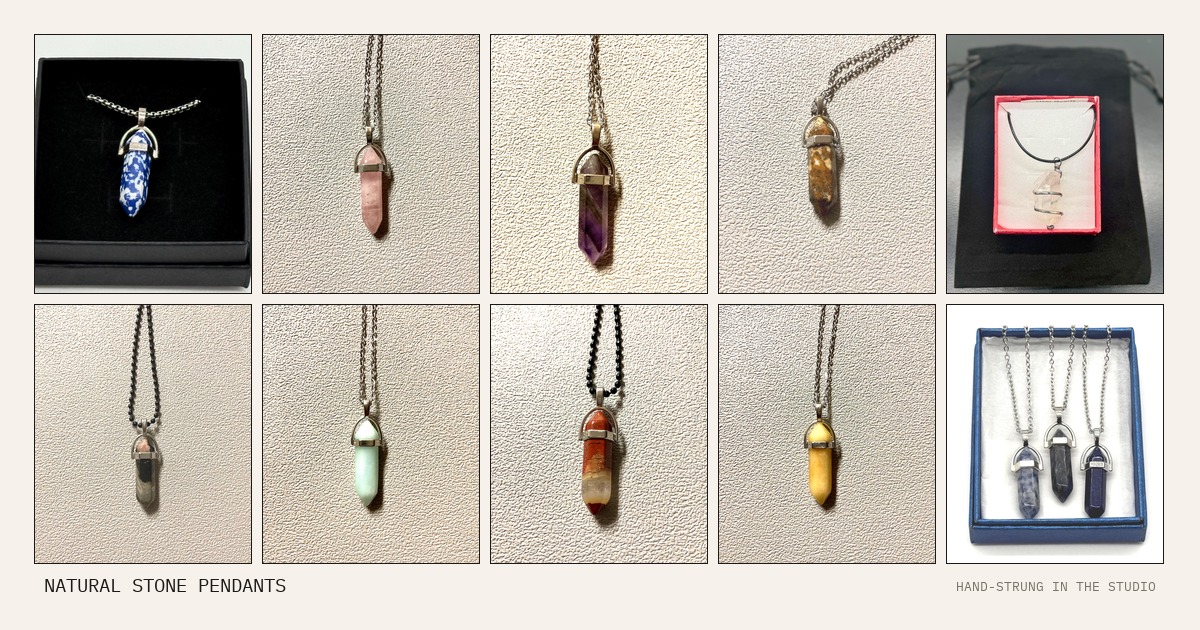
A natural stone necklace is exactly what it sounds like: a piece of jewelry built around a stone that came out of the ground, not out of a mold. The stone is cut or tumbled, polished, drilled or wrapped, and hung from a cord, chain, or bail. What makes it different from costume jewelry is the material itself — every piece carries the color, pattern, and small imperfections of the rock it started as.
This guide covers what to look for in a natural stone necklace, the stones we actually work with in the studio, and how to choose one that fits your life rather than just your feed.
What counts as a natural stone necklace
At minimum, a natural stone necklace has three parts: the stone, the finding or wrap that holds it, and the cord or chain that lets you wear it. The stone can be raw, tumbled into a smooth nugget, cut into a point, or carved into a heart or other shape. The setting can be a simple drilled bail, a wire wrap, or a bezel.
What matters is that the stone is real. A lot of what gets sold as 'natural stone' is actually dyed howlite, glass, resin, or reconstituted powder held together with dye and glue. Those pieces can be pretty, but they do not wear the same way and they rarely last. The rest of this guide will help you tell the difference before you buy.
The stones we carry in the studio
We work with the stones we can source consistently and photograph honestly. Here is what you will find in the shop right now:
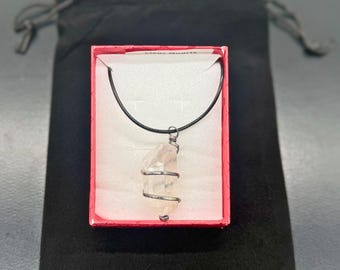
- Clear quartz — Mohs 7, transparent to slightly milky, and the easiest stone to layer with anything.
- Amethyst — purple quartz, also Mohs 7, with a calm color that reads well against silver and black cord.
- Sodalite — deep blue with white veining, Mohs 5.5–6, one of the most requested stones for gifting.
- Tiger's eye — golden brown with a subtle banded flash, Mohs 6.5–7, warm and neutral.
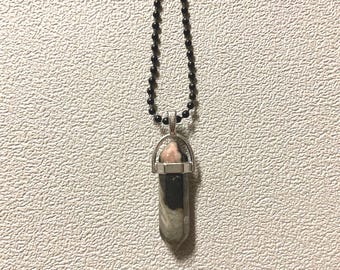
- Mahogany obsidian — volcanic glass streaked with iron-rich red-brown, Mohs 5–6, dramatic against bare skin.
- Red jasper — opaque brick red to rust, Mohs 6.5–7, earthy and low-maintenance.
- Rose quartz — soft pink, Mohs 7, the classic heart-shaped gift stone.
Each of these is a genuine mineral, photographed in-studio by Robert and Angela Anthony. We do not dye, treat, or rename them.
How to tell real stone from a fake
You do not need a lab. A few quick observations will catch most imitations:
- Look for variation. Real stone has color that moves — veins, bands, cloudy patches, tiny inclusions. Dyed or manufactured pieces tend to be too uniform.
- Check the temperature. Real stone feels cool when you pick it up and stays cool for a moment. Resin warms instantly; glass sits in between.
- Feel the weight. A real stone pendant has heft for its size. Plastic and resin feel noticeably lighter.
- Inspect the surface. Natural stone takes a polish but still has subtle texture under bright light. Glass is perfectly smooth; dyed stone often has color concentrated in cracks.
- Ask the seller. A reputable maker will tell you the exact stone and whether it has been treated. Vague names like 'new jade' or 'olive jade' usually mean a dyed or reconstituted substitute, not true jade.
For a deeper walkthrough, see our guide to spotting imitation stone jewelry.
How to choose a stone you will actually wear
The best stone is the one that fits your life, not just your aesthetic. Three questions help:
- How rough is your day? If you never take jewelry off, choose harder stones — clear quartz, amethyst, tiger's eye, red jasper. Softer stones like sodalite and mahogany obsidian need a little more care.
- What colors do you already wear? Cool wardrobes love sodalite, amethyst, and clear quartz. Warm wardrobes love tiger's eye, red jasper, and mahogany obsidian. Rose quartz works across both.
- What is the occasion? A heart-shaped pendant reads as a gift. A crystal point reads as everyday. A simple tumbled stone reads as understated.
If you are buying for someone else, our guide to heart-shaped stone pendants covers the symbolism of the most popular gift shape.
Caring for a natural stone necklace
Most damage to stone necklaces comes from storage, not wearing. A few habits keep them looking good:
- Store each piece separately. Harder stones scratch softer ones. A soft pouch or divided tray is enough.
- Take it off before sleep, showers, and swimming. Water and pressure wear out cord and findings faster than the stone itself.
- Wipe it after wearing. Skin oils dull polish over time. A microfiber cloth fixes most of it.
- Keep it out of direct sun. Amethyst and rose quartz can fade with prolonged UV exposure.
For the full routine, see our complete natural stone jewelry care guide.
A stone worth wearing is a stone worth knowing
Natural stone jewelry lasts because the material itself lasts. A well-made stone necklace does not go out of style — it just becomes more yours over time. The scratches, the polish, the way the color changes in different light: that is the point. Choose a real stone, care for it simply, and you will have something you can wear for years.
Photographed in-studio by Robert and Angela Anthony. Questions about a specific stone or a custom piece? Reach out anytime.
Featured pieces
From the studio
Hand-strung and finished in-studio. Every piece from our shop can be restrung or re-set at cost — just reach out.

Keep reading
Gemstone Guides
How to Tell Real Natural Stone from Imitation Jewelry
Spot dyed howlite, glass, resin, and other fake stones before you buy. A studio guide to testing necklaces by eye and by feel.
Gemstone Guides
Heart-Shaped Stone Pendants: The Quiet Symbolism of a Carved Stone Heart
Why the heart shape endures in stone jewelry — its history, symbolism, how different stones change the meaning, and how to choose one.
Stone Care & Cleaning
How to Care for Natural Stone Jewelry: A Complete Guide
Clean, store, and protect natural stone jewelry — from amethyst to obsidian — with a jeweler-tested care guide built to last.