
Gemstone Guides · Guide
Sodalite: The Blue Stone of Calm, Clarity, and Honest Communication
A complete guide to sodalite — its history, meaning, Mohs hardness, and why this deep-blue stone is a favorite for clear communication.
By Robert Anthony · · 9 min read
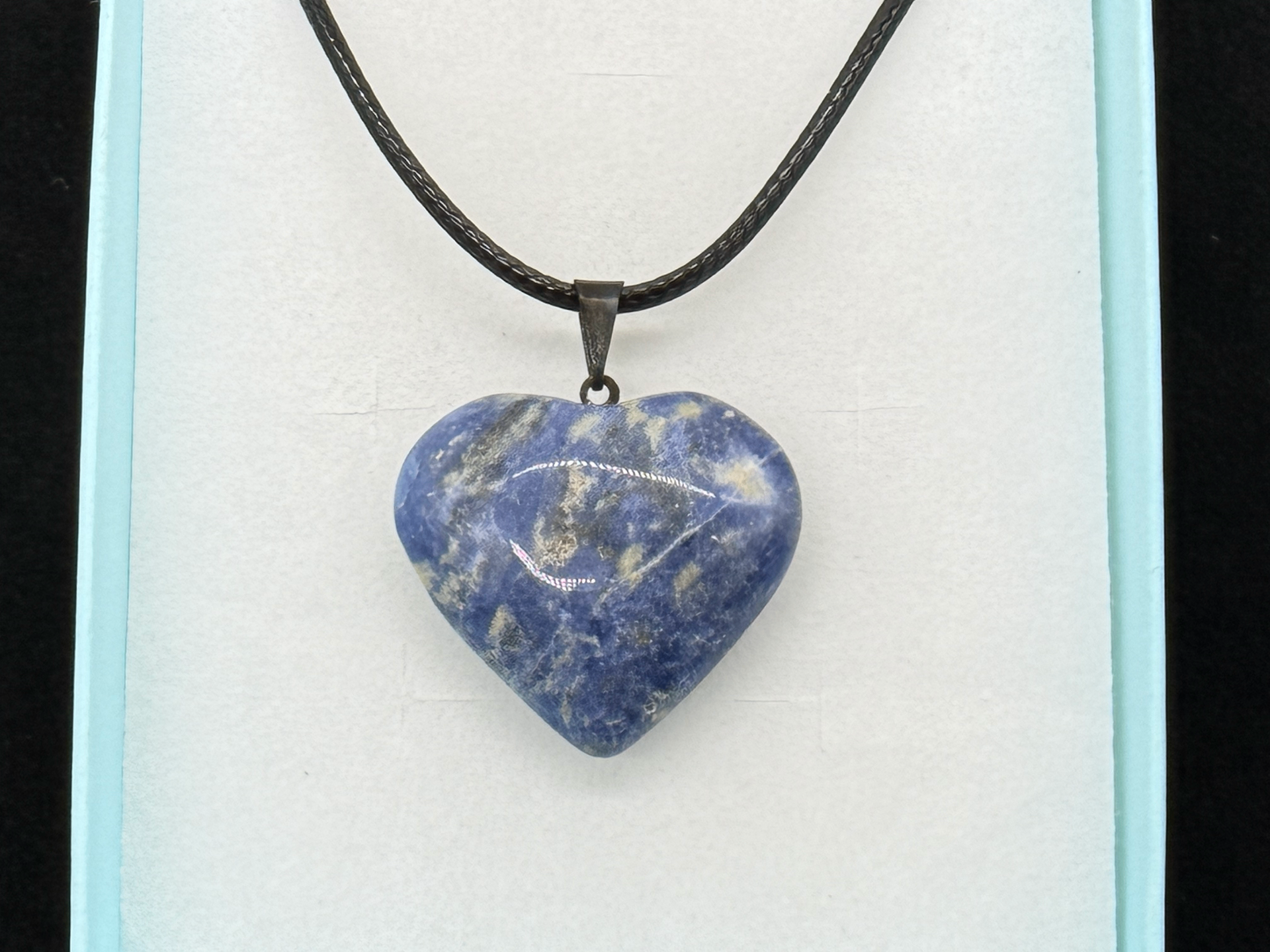
Sodalite is one of those stones people fall for slowly. It doesn't sparkle like amethyst or catch a room the way tiger's eye does. It sits quietly on a cord — a deep, ocean-dark blue veined with soft white calcite — and it grows on you. Ask anyone who wears one daily; they'll tell you they reach for it on the mornings they need to think clearly.
This guide covers what sodalite actually is, where it comes from, how it wears, what it has meant to the people who've carried it, and how to keep a piece of it looking the way it did the day you brought it home.
What sodalite is
Sodalite is a rock-forming mineral in the feldspathoid group, a sodium-rich cousin of lapis lazuli. Its chemical formula — Na₈(Al₆Si₆O₂₄)Cl₂ — is where it gets its name: sodium is the element it's built around. It typically forms in igneous rocks that cooled without much silica, which is why it shows up alongside minerals like nepheline and cancrinite rather than quartz. For a full mineralogical breakdown, Wikipedia's sodalite entry is a solid starting point.
On the Mohs hardness scale, sodalite lands between 5.5 and 6 — softer than quartz, harder than a fingernail. That's important later when we talk about care.
Sodalite vs. lapis lazuli
People mix these two up constantly, and it's an honest mistake. Lapis is technically a rock, and sodalite is one of the minerals inside it. What tells them apart is the pyrite: lapis lazuli usually has flecks of gold-colored pyrite scattered through it, while sodalite has soft white or cream veining from calcite. Sodalite also tends to run a cooler, more indigo blue; lapis leans warmer and more royal.
Where it comes from
The finest sodalite historically came from Bancroft, Ontario, and from Ice River in British Columbia — Canada is still a major source. Today most of the material on the market is mined in Brazil, Namibia, India, and Afghanistan. The stone in a well-made pendant has almost always crossed an ocean before it reaches you; part of what you're paying for, when you buy from a small shop, is somebody who cared where it came from.
A short history of the stone
Sodalite was first described scientifically in 1811, from a specimen collected in Greenland. But the material itself is much older than its name. Carved sodalite has been found in Caral, one of the oldest cities in the Americas, dated to around 2500 BC. The stone became a small sensation in the West after Princess Alexandra of Wales chose it as a decorative material for Marlborough House in 1901 — after which everyone wanted a piece of the 'Princess Blue.'
It's a good reminder that a stone doesn't have to be rare to be quietly loved. Sodalite has been quietly loved for a long time.
Meaning and symbolism
Every stone accumulates a folklore, and it's worth knowing what people have believed without taking any of it as medical fact. In the metaphysical tradition, sodalite is associated with:
- Clarity of thought — a stone for writers, students, and anyone whose work happens in their head
- Honest communication — traditionally tied to the throat, the place where thought becomes speech
- Calm under pressure — the deep blue is often described as steadying rather than energizing
- Self-trust — a quieter cousin to confidence; the ability to hear your own voice in a noisy room
You don't have to believe any of that for the stone to do its actual, ordinary work: giving you something small and beautiful to keep with you.
Why the heart shape suits it
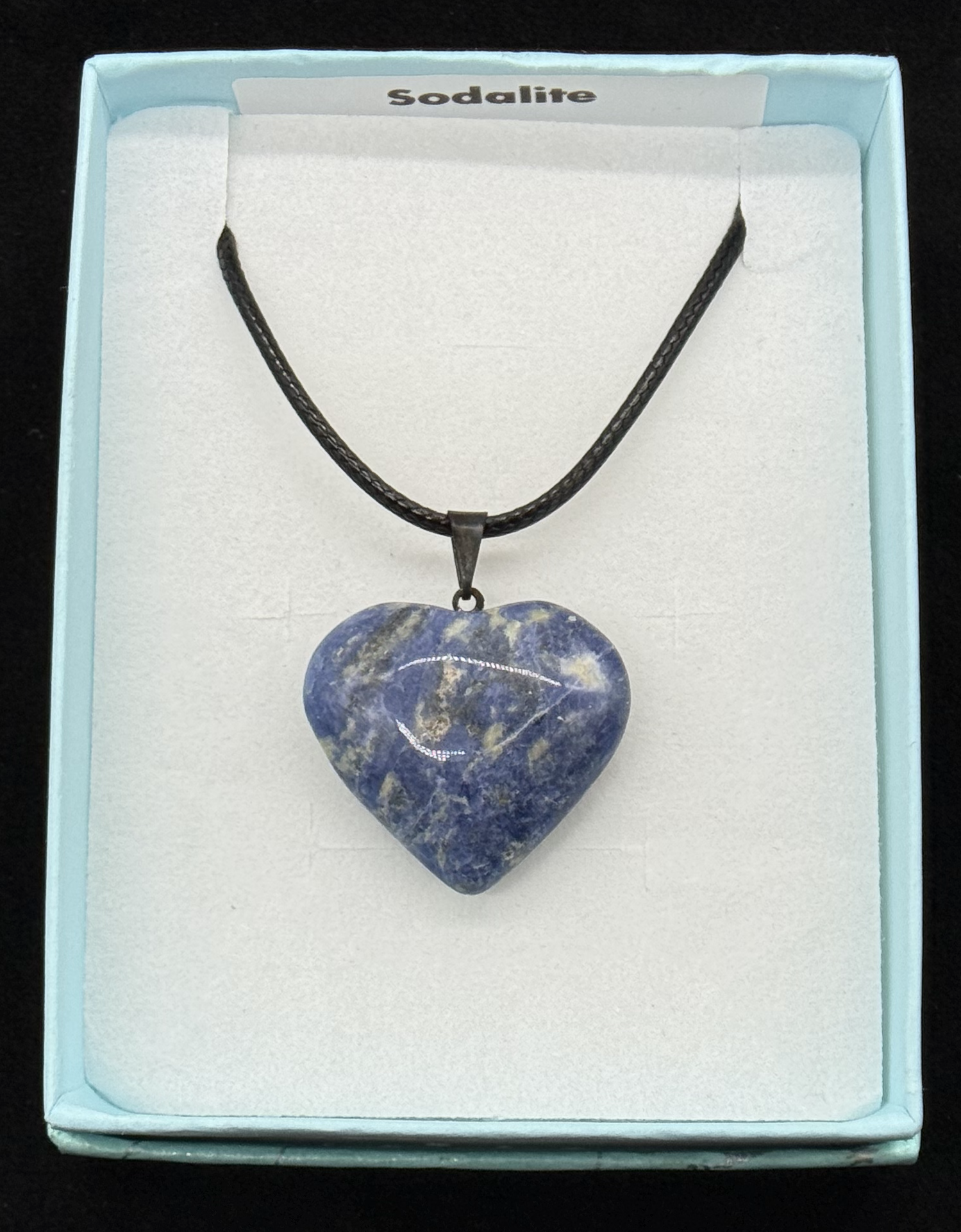
Polished sodalite is often carved into hearts, and there's a reason it wears well in that form. The calcite veining reads differently on every stone, so a heart pendant becomes genuinely one of a kind — no two hearts show the same pattern of white through the blue. The rounded shape also protects the softer edges of the stone, which matters when it lives on a cord that gets bumped through a day.
How to wear sodalite
Sodalite is dark enough to work as a neutral. It sits well against navy, cream, oatmeal, black, olive, and warm browns. It's a good day-to-night stone because it doesn't announce itself in daylight but reads richer under evening light.
- On a black or brown cord, it leans casual and grounded
- On a fine silver chain, it leans dressed and considered
- Layered under a longer chain, it lets the veining do the talking
If you want a deeper dive on lengths and layering, see how to choose necklace length and layering necklaces without looking cluttered.
Caring for sodalite
Sodalite is durable but not invincible. It's roughly the hardness of window glass, which means it can be scratched by anything harder — quartz dust, sand, and most other gemstones in a shared jewelry box.
- Clean it gently. Warm water, a drop of mild soap, and a soft cloth. No ultrasonic cleaners, no steam.
- Keep it dry. Take it off before showers, pools, and workouts. Prolonged water exposure dulls the polish and weakens the bail.
- Store it separately. A soft pouch or a lined tray, away from harder stones. The calcite veining is softer than the sodalite itself and will scuff first.
- Skip the sunbath. Sodalite can fade under long, direct UV. A windowsill is not a display case.
For a broader routine that covers every stone in a collection, see our complete natural stone jewelry care guide.
Who sodalite tends to suit
There's no rule, but if we had to sketch one: sodalite finds its way to people who do quiet, thinking work — writers, teachers, therapists, engineers, students in a stretch of hard exams, anyone in a season of learning to say what they mean. It's a good milestone stone for a graduation, a new job, or the start of a hard conversation.
A quiet closing note
Sodalite doesn't need a story to be worth wearing. It's a good-looking blue stone that ages well, feels cool against skin, and reminds you — every time you notice it — that you're the one deciding what to say next.
Photographed in-studio by Robert and Angela Anthony. If you'd like to talk about a specific stone or a custom piece, reach out anytime.
Keep reading
Gemstone Guides
Amethyst: Meaning, Hardness, and How to Wear It
A working guide to amethyst — its history, Mohs hardness, why it fades in sunlight, and how to keep the color rich.
Gemstone Guides
Rose Quartz: A Care Guide for the Softest Pink
Rose quartz care, sourcing, and how to keep the pink from fading — plus what makes it different from pink chalcedony.
Stone Care & Cleaning
How to Care for Natural Stone Jewelry: A Complete Guide
Clean, store, and protect natural stone jewelry — from amethyst to obsidian — with a jeweler-tested care guide built to last.