
Gemstone Guides · Guide
Red Jasper: The Grounding Stone of Endurance, Courage, and Steady Energy
A complete guide to red jasper — its geology, history, symbolism, and why this deep-red stone has been carried for thousands of years.
By Robert Anthony · · 9 min read
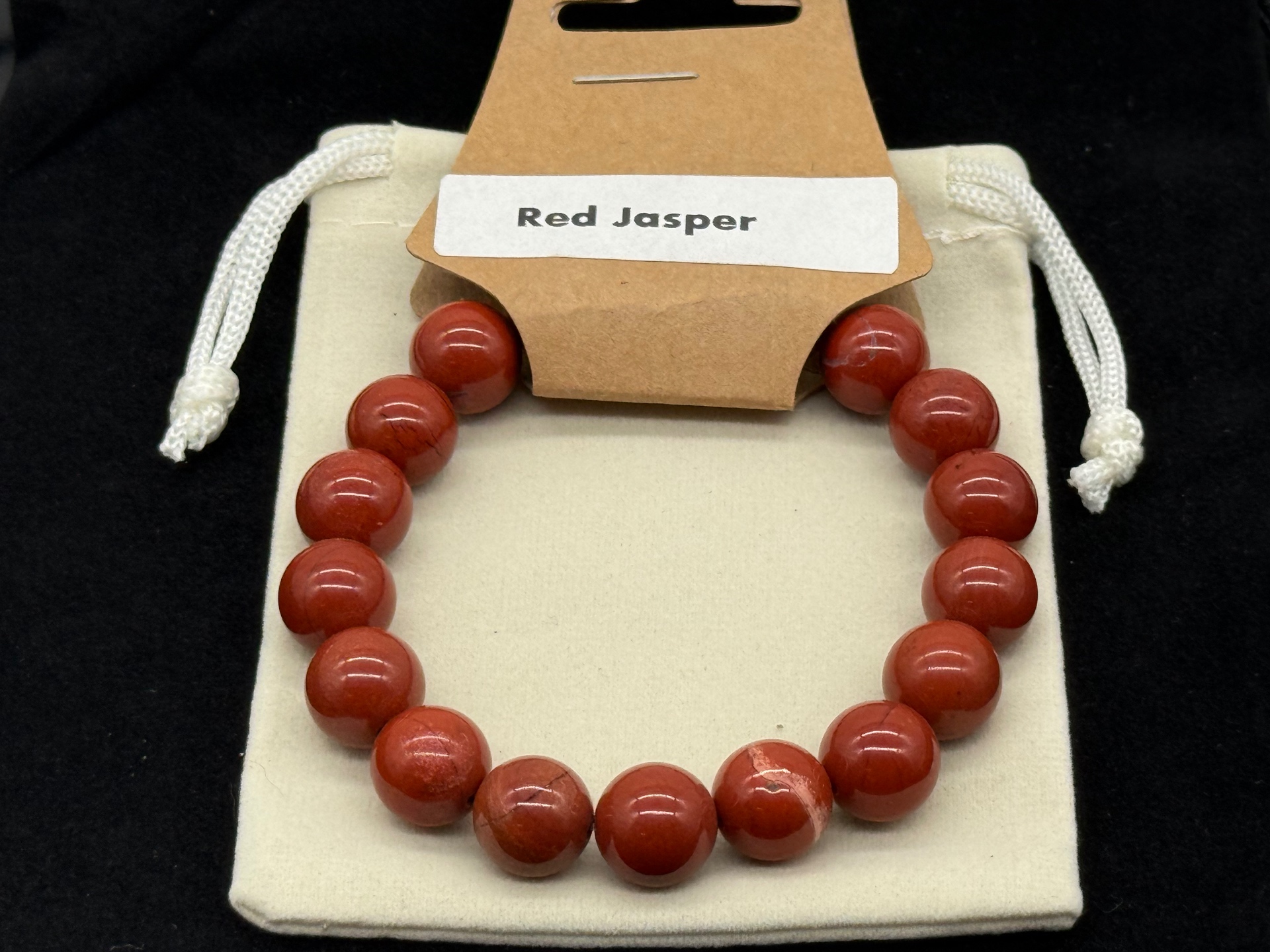
Red jasper is the kind of stone you feel before you understand. It has no sparkle and no drama — just a deep, warm, brick-and-oxblood red, sometimes shot through with darker veins or paler cloud. It sits heavy for its size, cool at first against skin, then warm. People have been carrying it for at least five thousand years, and the reasons haven't changed much: it's steady, it's beautiful, and it stays.
This guide covers what red jasper actually is, where it comes from, what it has meant to the cultures that valued it, how it wears, and how to keep a piece of it looking the way it did the day you brought it home.
What red jasper is
Jasper is an opaque variety of chalcedony — a microcrystalline form of quartz. Red jasper gets its color from finely dispersed iron oxide (hematite) locked inside the silica matrix as it formed. It's the same iron chemistry that colors rust, terracotta, and Mars; in jasper, that iron has been sealed under pressure and heat into something that will hold its color essentially forever. For a full mineralogical breakdown, Wikipedia's jasper entry is a good starting point.
On the Mohs hardness scale, red jasper sits at 6.5 to 7 — harder than sodalite, roughly the hardness of quartz itself. That's a useful number to remember when we get to care.
Red jasper vs. carnelian vs. red agate
These three get confused constantly. Carnelian is translucent — you can hold it up to a window and see light pass through. Red agate is banded and often translucent as well. Red jasper is fully opaque; no light gets through it. If a bead looks like a stained-glass window when you hold it up, it isn't jasper.
Where it comes from
Red jasper is one of the more widely distributed gemstones in the world. Significant deposits are found in India, Brazil, Madagascar, Russia, Australia, Venezuela, and across the western United States — Oregon, Idaho, and Arizona have all produced excellent material. Its abundance is part of why it has never been a status stone; it belongs to working people, and always has.
A short history of the stone
Red jasper is one of the oldest documented gemstones in human use. The word 'jasper' comes from the Old French jaspre, which traces back through Latin and Greek to a Semitic root — yashepheh in Hebrew, yashpu in Akkadian — meaning simply 'spotted stone.'
- Ancient Egypt — red jasper was carved into amulets, scarabs, and the tyet (the Knot of Isis), often placed on the throats of the dead. The Book of the Dead specifically prescribes a red jasper tyet for protection in the afterlife.
- Mesopotamia — cylinder seals in red jasper appear in the archaeological record from roughly 3000 BC onward.
- Ancient Greece and Rome — carried by soldiers as a stone of courage; Pliny the Elder writes about jasper in his Natural History in the first century.
- Native North America — worked into tools, points, and ceremonial objects long before European contact.
- Medieval Europe — set into reliquaries and worn by knights; it's one of the twelve stones named in the foundations of the New Jerusalem in the Book of Revelation.
Few stones have been continuously loved for as long. It is, in the honest sense, an ancestral stone.
Meaning and symbolism
Every stone accumulates a folklore, and it's worth knowing what people have believed without taking any of it as medical fact. In the metaphysical tradition, red jasper is associated with:
- Grounding — a stone for staying in your body when the day pulls at you
- Endurance — the long, steady kind of courage rather than the burst kind; a stone for finishing what you start
- Physical vitality — historically tied to the root of the body and to steady, warm energy
- Protection — the oldest and most consistent association across cultures; a working person's shield
- Boundaries — the quiet no; the ability to hold your ground without getting louder
You don't have to believe any of that for the stone to do its actual, ordinary work: giving you something small and beautiful to keep with you.
Why the beaded bracelet suits it
Red jasper is often strung as a bead bracelet, and there's a reason it wears well in that form. Each bead is polished from a slightly different piece of the same stone, so the color reads as a range — some beads lean brick, some lean oxblood, some carry a faint darker vein. Worn together on a cord, they become a small, continuous record of the stone itself.
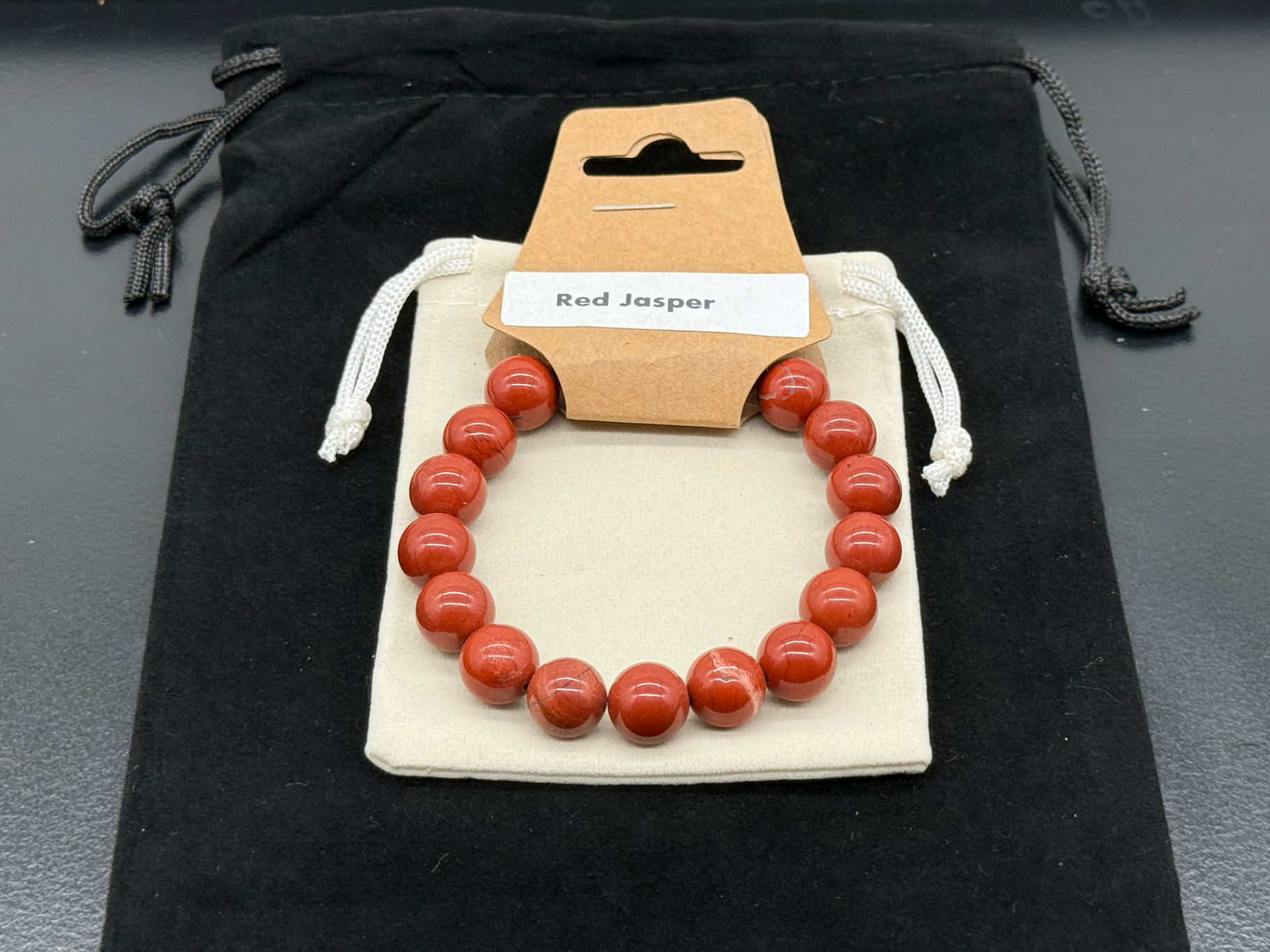
The round bead is also the most forgiving shape red jasper takes. There are no thin edges to chip, no facets to dull. A well-strung bracelet, on a good elastic or a knotted cord, will outlast most of what happens to it.
How to wear red jasper
Red jasper is warm-toned and reads as a neutral against most earth palettes. It sits well against olive, cream, camel, denim, black, and warm browns. It pairs cleanly with brass, copper, and warm-tone silver; against high-polish white metals it can look slightly stranded, so we tend to keep it on cord or leather.
- As a single bracelet, it reads quiet and grounded
- Stacked with a plain leather cord or a second stone (tiger's eye, mahogany obsidian), it reads considered
- Worn as a pair — one on each wrist — it reads deliberate; the two bracelets balance each other visually
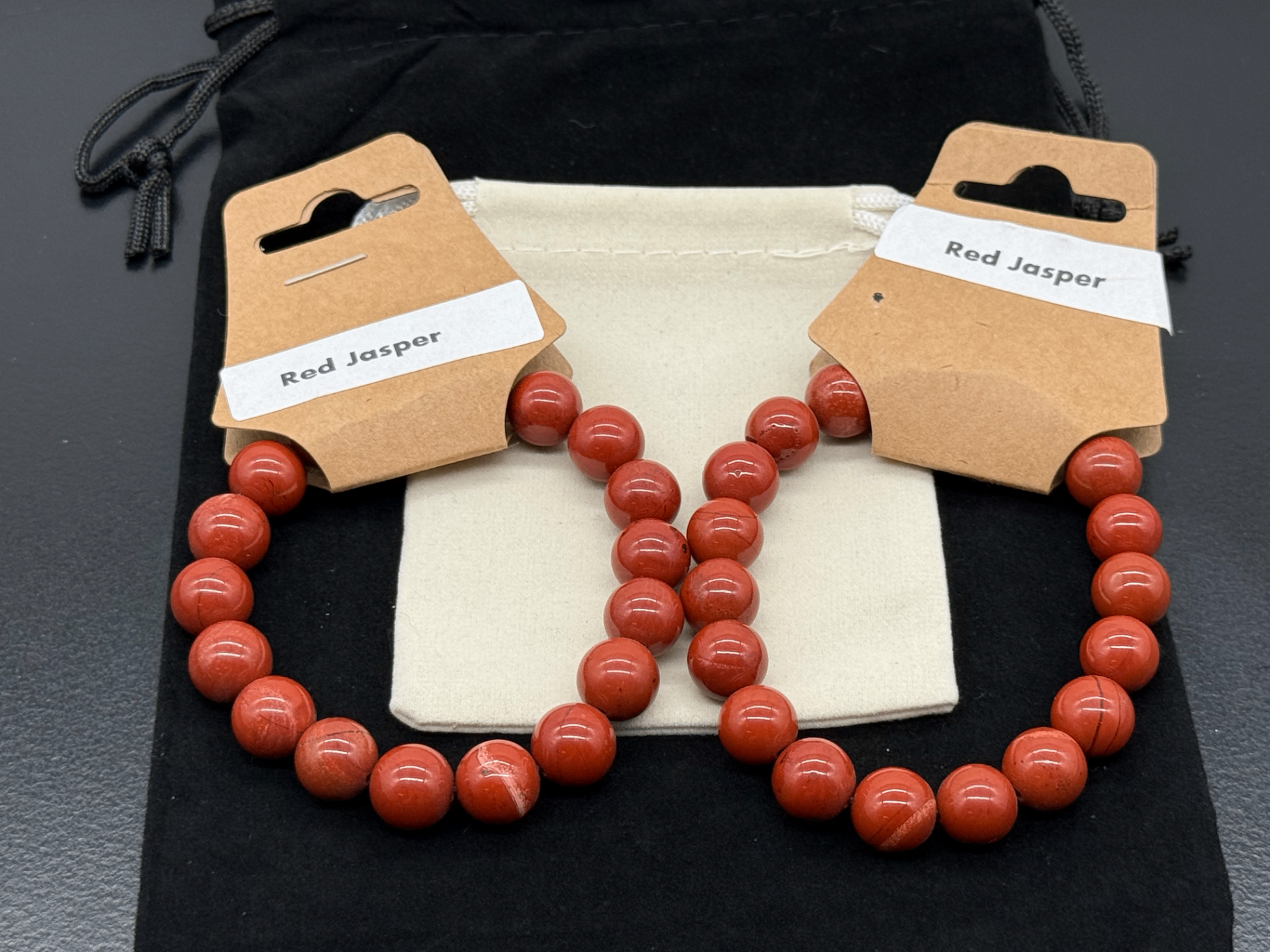
For a deeper dive on wearing sets and pairs, see our guide to layering without looking cluttered.
Caring for red jasper
Red jasper is one of the more durable stones you can wear daily. At 6.5–7 on the Mohs scale, it resists scratching from most household surfaces, and the iron pigment is locked inside the silica rather than sitting on the surface, so the color won't rub off. Still, a little care goes a long way.
- Clean it gently. Warm water, a drop of mild soap, a soft cloth. Skip ultrasonic cleaners and steam.
- Keep it off in water. Elastic cords weaken faster than the stone does — showers, pools, and hot tubs will shorten the life of a bracelet even if the beads outlive us.
- Store it separately. Not because red jasper is fragile, but because it will happily scratch softer stones in a shared box.
- Skip heavy chemicals. Lotion, perfume, and sunscreen go on before the bracelet, not after.
For a broader routine that covers every stone in a collection, see our complete natural stone jewelry care guide.
Who red jasper tends to suit
There's no rule, but if we had to sketch one: red jasper finds its way to people whose work requires staying — nurses, firefighters, teachers, tradespeople, parents in the young years, anyone in a long stretch that asks more of their body than of their words. It's a good milestone stone for the beginning of something hard: a training program, a first responder's oath, a recovery, a return.
If you're drawn to the deeper symbolic side of stones, our sodalite guide covers the cool, thinking counterpart to red jasper's warm, working energy — the two make a natural pair.
A quiet closing note
Red jasper doesn't need a story to be worth wearing. It's a warm, honest red that has kept its color for millennia, feels good against skin, and reminds you — every time you notice it — that you're still here, still doing the work, still standing.
Photographed in-studio by Robert and Angela Anthony. If you'd like to talk about a specific stone or a custom piece, reach out anytime.
Keep reading
Gemstone Guides
Sodalite: The Blue Stone of Calm, Clarity, and Honest Communication
A complete guide to sodalite — its history, meaning, Mohs hardness, and why this deep-blue stone is a favorite for clear communication.
Gemstone Guides
Heart-Shaped Stone Pendants: The Quiet Symbolism of a Carved Stone Heart
Why the heart shape endures in stone jewelry — its history, symbolism, how different stones change the meaning, and how to choose one.
Stone Care & Cleaning
How to Care for Natural Stone Jewelry: A Complete Guide
Clean, store, and protect natural stone jewelry — from amethyst to obsidian — with a jeweler-tested care guide built to last.