
Gemstone Guides · Evergreen Guide
Serpentine: The Quiet Green Stone — Meaning, Properties, and History
A studio guide to serpentine — where it comes from, how it got the name 'new jade,' what it means across cultures, and how it wears.
By Robert Anthony · · 10 min read
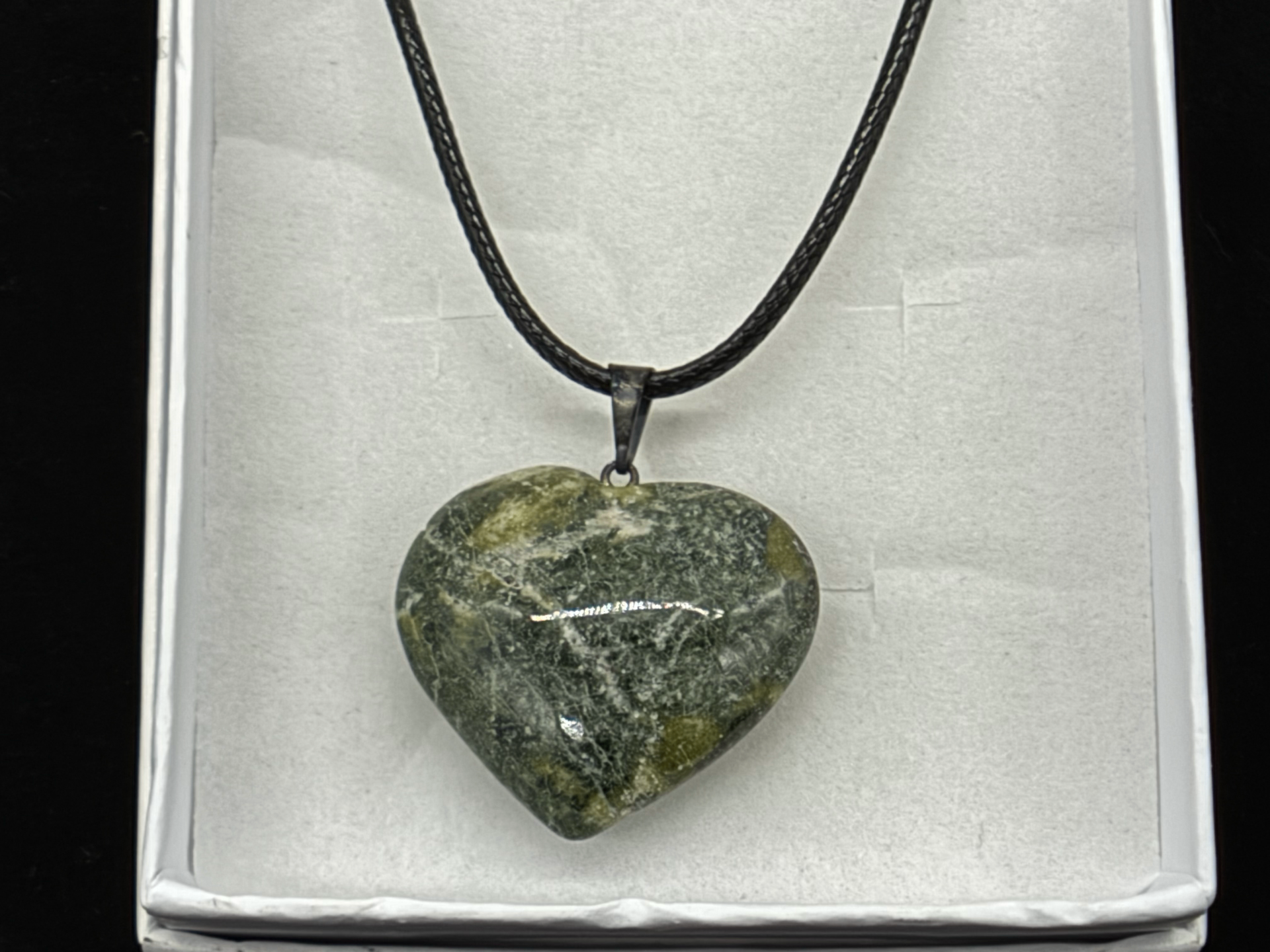
Serpentine is one of those stones that never asks for attention and always rewards it. It is soft green, sometimes almost gray, veined with white and lighter apple-green pools, and polished to a low waxy shine rather than a glassy one. Held in the hand it feels warmer and lighter than quartz, and it has the kind of patterned surface that keeps changing the longer you look at it — no two pieces are alike.
This is a plain-language guide to serpentine — how it forms, why people have called it 'new jade' for over a century, what it has meant across cultures, and how to wear and care for it well.
What serpentine actually is
Serpentine isn't a single mineral — it's a group of related magnesium silicate minerals (antigorite, lizardite, and chrysotile among them) that share a soft, layered structure. The serpentine subgroup forms when peridotite and other iron-magnesium rocks deep in the earth get altered by hot water over long periods of time, a process geologists call serpentinization. The result is a rock that's often greasy or waxy to the touch, with a scaled or veined pattern that reminded early namers of snakeskin — hence the name.
On the hardness scale, serpentine runs from Mohs 3 to 6 depending on the variety, which is softer than quartz (7) and closer to a fingernail on the low end. That has real implications for how a serpentine piece should be worn and stored — more on that below.
Why it's called 'new jade'
Walk into any bead shop and you'll see serpentine sold under names like 'new jade,' 'olive jade,' 'Korean jade,' or 'Suzhou jade.' None of those are jade in the mineralogical sense — real jade is either jadeite or nephrite, both harder and denser stones. Serpentine looks similar enough to the softer green jades that the trade adopted it as an affordable stand-in more than a hundred years ago, and the nicknames stuck.
That isn't necessarily deceptive — much of the world's carved 'jade' in tourist markets has always been serpentine, and reputable sellers will say so if you ask. But if a piece is priced like real jade and called 'new jade,' the pricing is wrong. Serpentine on its own is a lovely, honest stone; it doesn't need the borrowed name.
A very short history
Serpentine has been carved for at least six thousand years. Neolithic communities in the Alps and the Balkans made polished serpentine axe-heads and pendants; Chinese carvers used it alongside true jade for burial figures and ritual objects; Roman workshops turned it on lathes for cups and small containers. The stone travels well through history because it's abundant, easy to shape, and takes a soft polish that ages gracefully rather than looking dated.
Traditional associations follow the color. Green stones have almost universally been read as stones of the earth, of growth, and of steady health — serpentine included. In parts of Central and South America it was worn as a protective amulet, particularly against snakebite, on the old folk logic that the patterned stone resembled the animal it was meant to ward off.
Symbolism and what serpentine 'says'
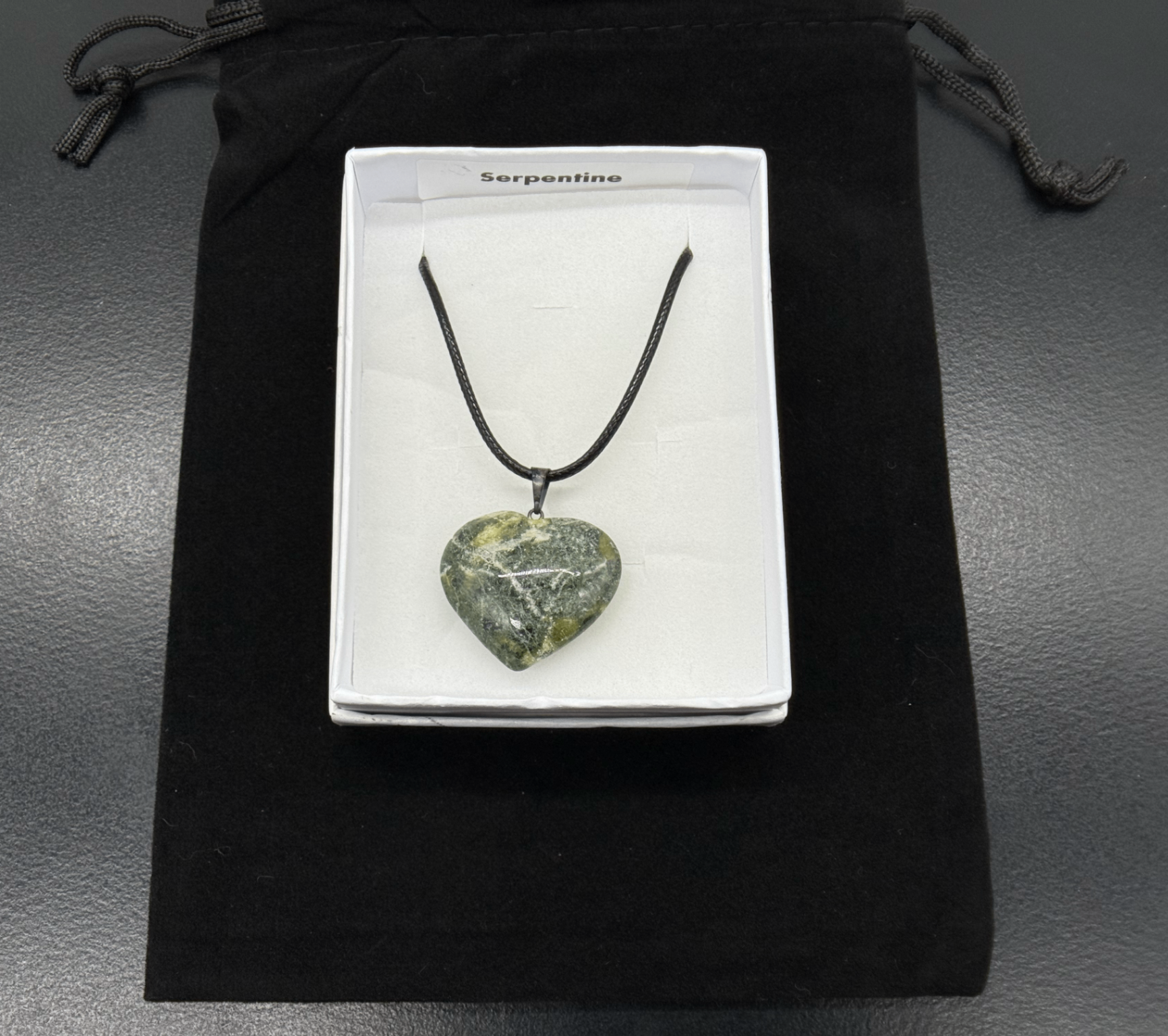
If clear quartz is the neutral in a stone wardrobe and obsidian is the protective one, serpentine is the grounded one. The color reads calm rather than showy; the pattern reads natural rather than manufactured. A serpentine pendant tends to suit people who don't want jewelry to announce itself — it looks at home on a linen collar, a wool sweater, or bare skin.
In the crystal tradition serpentine is associated with earth energy, patience, and the slow work of clearing something you've been carrying too long. You don't have to buy the metaphysics to see why: it's a stone that looks like a river bed, and it wears like one — quietly, over years.
How serpentine wears as jewelry
Two things to know before you commit to a serpentine piece as a daily wear:
- It's soft. At Mohs 3–6 it will scratch on a keychain, in a shared jewelry tray, or knocked against a granite countertop. Serpentine wants its own pouch.
- It takes a waxy polish, not a glassy one. That's not a defect — it's the material. If a piece is mirror-shiny like glass, it's either coated (which will wear off) or not actually serpentine.
Treated well, though, serpentine ages beautifully. The soft polish deepens with skin contact, and the pattern shifts slightly as tiny surface abrasions catch light differently. A serpentine heart worn for ten years looks lived-in rather than worn out.
Real serpentine vs. dyed imitations
The most common substitute isn't glass — it's dyed howlite or dyed magnesite masquerading as 'green jade.' A few quick tells:
- Color depth. Real serpentine has color that varies across a single piece — pooled darker greens, pale cream veins, occasional yellow-green flecks. Dyed stone tends to be uniform, with color concentrated in cracks where the dye pooled.
- Feel. Serpentine is slightly waxy or greasy to the touch, especially against a fingernail. Dyed limestone-family stones (howlite, magnesite) feel chalky.
- Weight. Serpentine is only moderately dense — noticeably lighter than a similarly sized quartz or obsidian piece, but not weightless the way plastic or resin is.
- Under water. A drop of water on real serpentine beads slightly; on dyed porous stone it soaks in and darkens the surface for a few seconds.
Pairing serpentine with other stones
Because serpentine sits in the muted green range, it pairs cleanly with almost any other natural stone as long as the surroundings stay quiet:
- Clear quartz — the neutral. Clear next to green reads fresh and considered.
- Sodalite — deep blue next to muted green is a classic earth-and-sea pairing.
- Mahogany obsidian — warm red-brown against cool green gives contrast without clashing.
- Red jasper — earth-toned and grounded; two 'ground' stones layered together read intentional rather than matchy.
For length and layering, see how to choose necklace length and layering necklaces without looking cluttered. For the shape specifically, see our guide to heart-shaped stone pendants.
Caring for a serpentine piece
- Take it off before showers, pools, and sleep. The stone tolerates water briefly, but the cord and bail don't like repeated soakings.
- Clean it with a soft dry cloth. No ultrasonic cleaners, no ammonia, no commercial jewelry dips — the softness of the stone means chemicals can etch or dull the polish.
- Store it in its own pouch. Anything harder than Mohs 6 — most other stones, most metals, most zippers — will scratch it if they share a drawer.
- Keep it out of prolonged direct sun. Serpentine is more UV-stable than amethyst or rose quartz, but sustained sun and heat can dry out the natural waxy surface over years.
For a full routine that works across natural stones, see our complete natural stone jewelry care guide.
A stone worth choosing on its own terms
The best case for serpentine isn't that it looks like jade — it's that it looks like serpentine. The mossy greens, the cream veins, the slightly waxy polish, the way one piece never quite matches another: none of that is a compromise. It's the reason to buy the stone.
If you're building a small collection of natural stone jewelry and want one grounded green piece that will layer with almost anything and won't go out of style, serpentine is a strong first choice. It has been on people's necks for six thousand years for a reason.
Photographed in-studio by Robert and Angela Anthony. Questions about a specific stone or a custom piece? Reach out anytime.
Keep reading
Gemstone Guides
Heart-Shaped Stone Pendants: The Quiet Symbolism of a Carved Stone Heart
Why the heart shape endures in stone jewelry — its history, symbolism, how different stones change the meaning, and how to choose one.
Gemstone Guides
Clear Quartz: The Master Stone — Meaning, Properties, and History
A studio guide to clear quartz — where it comes from, how it forms, why it's called the 'master stone,' and how to tell it from glass.
Stone Care & Cleaning
How to Care for Natural Stone Jewelry: A Complete Guide
Clean, store, and protect natural stone jewelry — from amethyst to obsidian — with a jeweler-tested care guide built to last.