Studio Notes · Guide
A Free Studio Photography Gallery for Writers, Artists, and Creators
Original in-studio photographs of natural stone jewelry and handmade pendants — free to use in articles and video with attribution.
By Robert Anthony · · 6 min read
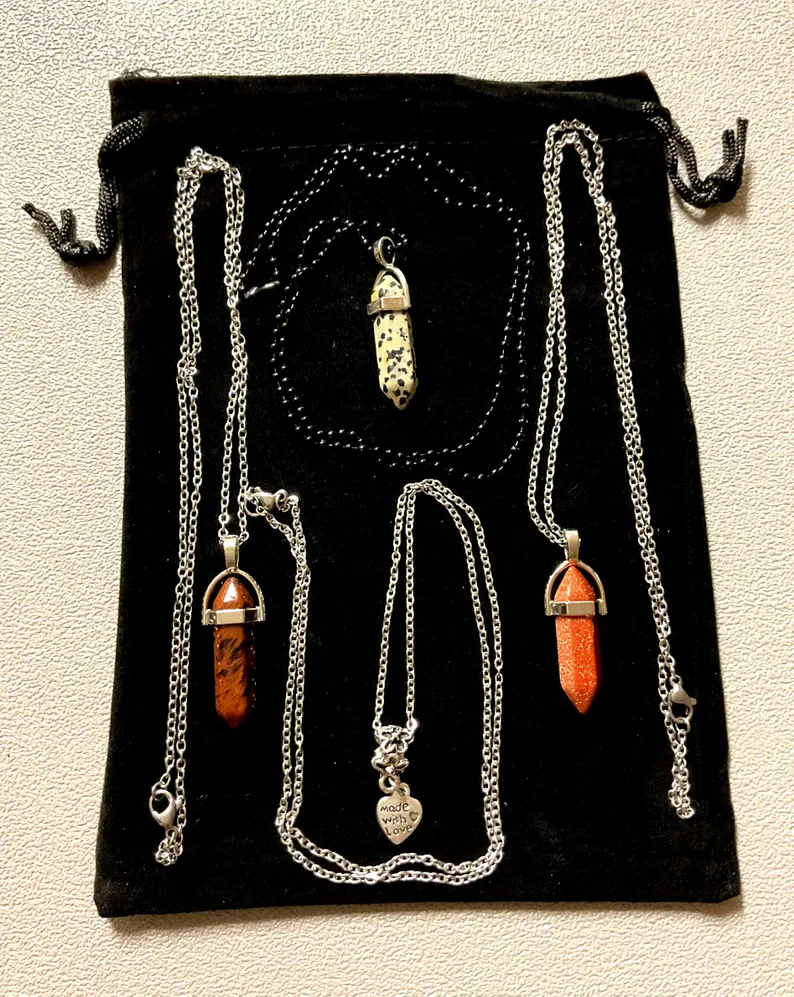
Good photography of handmade jewelry is surprisingly hard to find. Stock sites are full of the same over-lit "gemstone on white" shots, and the few honest studio images that exist are locked behind licensing fees that don't make sense for a personal blog, a school project, or a small artist's mood board. We wanted to fix that piece of the internet for the corner we work in. Our full studio gallery is free to use — with credit — for anyone writing, drawing, filming, or building something that could use a real photograph of a real handmade piece.
What's in the gallery
Every image was shot in our home studio by Robert and Angela on the same pieces we sell. Nothing is staged with rented product, nothing is AI-generated, and nothing is retouched beyond basic color correction. The gallery is organized loosely by subject and covers the categories we make most:
- Natural stone pendants — sodalite, amethyst, mahogany obsidian, clear quartz, and dalmatian jasper hearts and points
- Wire-wrapped crystals — hand-wrapped amethyst and clear quartz points in gift boxes and macro close-ups
- Stone bead bracelets — red jasper and bloodstone, on the wrist and flat
- Silver pendants — matched cross pairs and open-heart pendants in gift boxes
- Detail and macro shots — grain, veining, wire wraps, and mineral patterning close enough to draw from
Browse the full set on the gallery page. Every image opens to a full-size view with a download button, and every filename is descriptive so it drops cleanly into a folder.
Why we're releasing them for free
Two reasons. First, the practical one: real photographs of handmade objects are what make articles about jewelry, crystals, and small-batch craft feel true. When a writer covers a stone we work with, they shouldn't have to choose between a generic stock photo and paying a licensing fee that outweighs the article. Second, the philosophical one: we're a two-person studio, and the way small studios reach new people is by being useful before we're transactional. Institutions like the Smithsonian Open Access program have made the case at scale — freely available images multiply the audience for the work, not diminish it.
How to use the images
The license is simple. You may use any photograph from the studio gallery in articles, blog posts, newsletters, school and educational materials, video essays, mood boards, reference for drawing or painting, and social-media posts. Commercial use is fine — including monetized blogs, YouTube, and Substack — as long as the credit line stays intact.
The credit line
Credit us as Robert Anthony Art, and where the medium supports it, link to our homepage. A caption like this is perfect:
Photo: Robert Anthony Art — robertanthonyart.com
For attribution style in general, the Creative Commons attribution guide is a good primer if you're new to citing images.
What not to do
- Don't re-upload the gallery to stock-photo sites or claim the images as your own.
- Don't remove or obscure the credit line where it's rendered on-page.
- Don't use the photographs to imply endorsement of unrelated products, political campaigns, or AI training datasets.
- Don't feed them into generative-AI training corpora — that's the one line we hold.
A few practical tips for using them well
Match the caption to the photo, not the other way around
The most common mistake we see is a great photo paired with a caption that describes something the image doesn't show. If you're writing about, say, red jasper's hardness, use the macro of the beads — not the boxed pendant. Our alt text on the gallery describes each image plainly; if that description doesn't match your paragraph, pick a different photo.
Compress before publishing
The originals are large so illustrators and print projects have enough resolution to work with. For a blog post you almost never need the full file — resize to about 1200px on the long edge and export at 80% JPEG or WebP. Google's image SEO guidance covers the details, and a lighter image will always outrank a heavier one for the same query.
Keep the alt text real
Copy the plain-language alt text from the gallery instead of writing generic alt like "stone necklace." Screen readers, search engines, and future editors all benefit from descriptive alt text that says what's actually in the frame.
Who this is for
Bloggers writing about crystal meanings, jewelry-care routines, or slow craft. Illustrators building reference libraries for stone and metal. Teachers pulling images for lessons on mineralogy or design. Small e-commerce founders who need honest photography of comparable pieces without hiring a photographer for a single post. Video essayists on aesthetics, symbolism, or the return of handmade goods. If that's you, take what you need.
If you want to feature the pieces themselves
Everything photographed in the gallery is a real object we've made or currently make. If you want to write about a specific piece, the shop has the ones currently available, and our note on handmade versus mass-produced covers how each piece is made. For press requests, high-resolution files beyond what's on the gallery page, or to arrange a specific shot, message the studio and we'll get back within a business day.
A quiet ask
If the images help you build something you're proud of, we'd love to see it. Send a link through the contact page — we keep a running list of writers, illustrators, and creators who've used the gallery, and we occasionally share their work on the journal. That's the whole loop: real photographs, credited well, feeding real work.
Keep reading
Studio Notes
Handmade vs. Mass-Produced Jewelry: What Actually Differs
A practical breakdown of what changes when jewelry is made by hand — construction, materials, finishing, and longevity.
Studio Notes
Why We Source Natural Stones (and How We Choose Them)
A studio note on why every stone we sell is natural, how we vet suppliers, and what that means for the pieces you wear.
Gemstone Guides
Wire-Wrapped Crystal Pendants: Craft, Character, and Care
How wire-wrapped crystal pendants are made, why every piece is one-of-a-kind, and how to care for the wrap and the stone.
Gemstone Guides
Heart-Shaped Stone Pendants: The Quiet Symbolism of a Carved Stone Heart
Why the heart shape endures in stone jewelry — its history, symbolism, how different stones change the meaning, and how to choose one.