
Gemstone Guides · Guide
Wire-Wrapped Crystal Pendants: Craft, Character, and Care
How wire-wrapped crystal pendants are made, why every piece is one-of-a-kind, and how to care for the wrap and the stone.
By Robert Anthony · · 6 min read
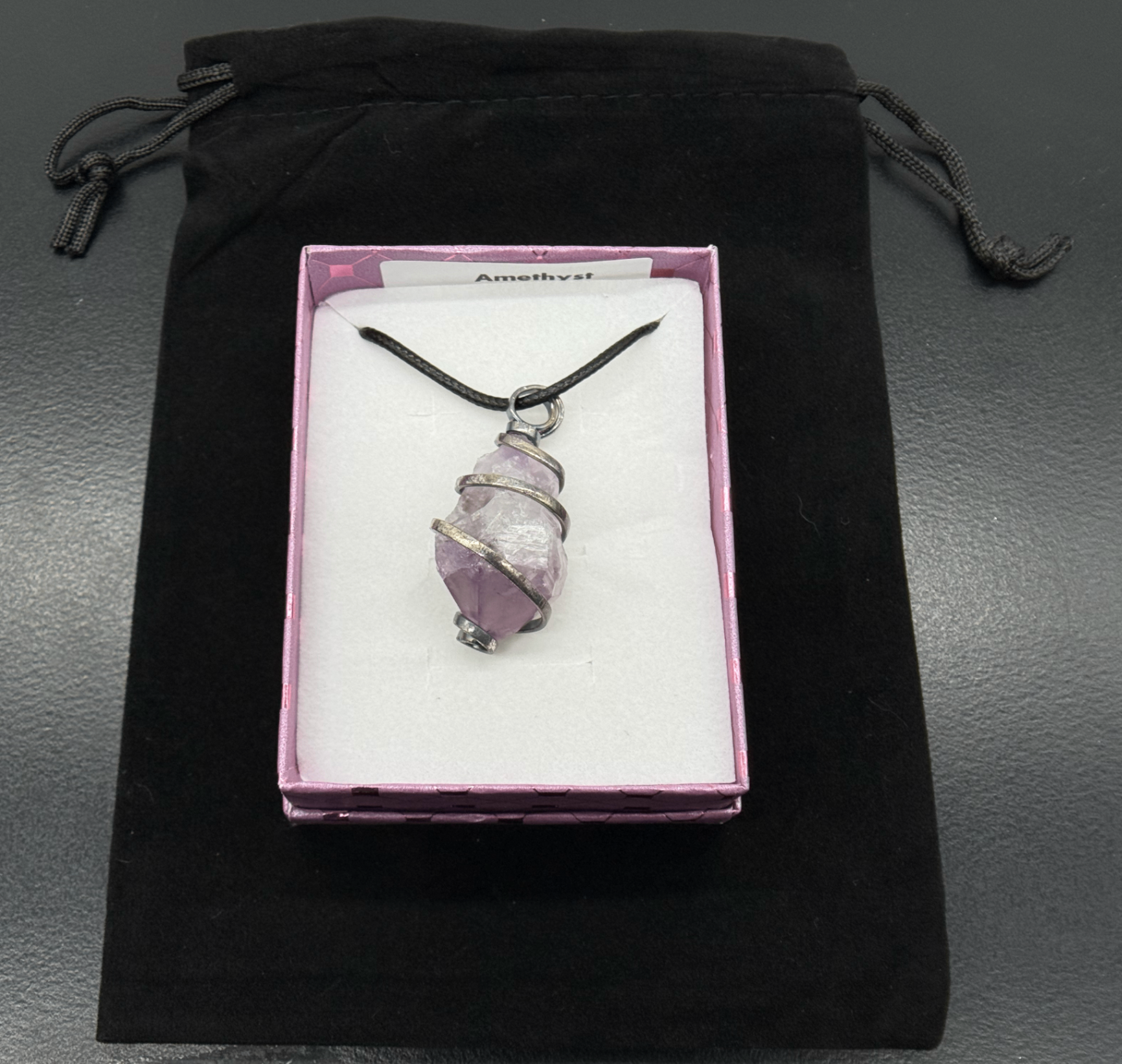
A wire-wrapped crystal pendant is a small piece of engineering. The wrap has to grip a stone that was never cut to a jeweler's tolerance — every crystal is a different shape, with different weight, different angles, different fragile points — and it has to do it without adhesive, without setting compound, and without hiding the stone. Done well, the wrap becomes part of the piece. Done poorly, it slips, snags, or scratches the crystal it was meant to hold.
Every wrap we do in the studio is done by hand around a specific stone. Robert selects the crystal first — a raw amethyst point, a clear quartz shard, a sodalite tumble — and the wire follows the stone, not the other way around. Two pendants of the same mineral end up looking like siblings, not copies.
How a wrap actually holds
A good wrap uses tension, not glue. The wire loops the stone at two or three natural pinch points — usually the taper of a point and a wider midsection — then twists back on itself to lock. The bail (the loop at the top the cord passes through) is formed from the same continuous piece of wire, so there is no seam that can pull open.
- Silver-tone wire: soft enough to shape, work-hardened by the twisting itself.
- Bail: integral to the wrap — never a separate soldered jump ring.
- Cord: waxed black cotton, adjustable in length, sealed at the ends.
Why every piece is one of a kind
Raw crystal is not calibrated. A clear quartz point is going to have facets and inclusions unique to the pocket it grew in; a raw amethyst varies from pale lilac to deep violet depending on iron content and depth of formation. The wrap adapts to whatever the stone is, which is why we can't produce two identical pendants even when we try.
For collectors who want to read further on quartz varieties, GIA's overview and Mindat's mineral data are the two references we return to.
Caring for a wrapped pendant
- Take it off before showering. The wire is fine, but wet cord ages faster.
- Store flat. Hanging a wrap by the bail long-term can slowly stretch the loop.
- Wipe with a soft cloth. Skip the ultrasonic — vibration can loosen a tension wrap.
- Keep amethyst out of direct sun. UV fades the purple over time.
The full routine — for stone and setting — is in our stone care guide.
What to expect when you unbox one
A wrapped pendant arrives in a small gift box with a labeled insert naming the stone. The cord is pre-tied at a comfortable length; the wrap is finished but not lacquered — it will darken slightly over years of wear, which we consider a feature. Store it flat and keep it dry to help the wrap last.
Featured pieces
From the studio
Hand-strung and finished in-studio. Every piece from our shop can be restrung or re-set at cost — just reach out.

Keep reading
Gemstone Guides
Amethyst: Meaning, Hardness, and How to Wear It
A working guide to amethyst — its history, Mohs hardness, why it fades in sunlight, and how to keep the color rich.
Gemstone Guides
Clear Quartz: The Master Stone — Meaning, Properties, and History
A studio guide to clear quartz — where it comes from, how it forms, why it's called the 'master stone,' and how to tell it from glass.
Stone Care & Cleaning
How to Care for Natural Stone Jewelry: A Complete Guide
Clean, store, and protect natural stone jewelry — from amethyst to obsidian — with a jeweler-tested care guide built to last.