Laser Etching & Craft · Guide
Laser Engraved Cork Coasters: How to Choose, Use, and Care for Them
What makes cork the right coaster material, how laser engraving behaves on it, and a simple care routine that keeps a set looking sharp for years.
By Robert Anthony · · 7 min read
A coaster is one of the few handmade objects that gets used every single day and almost never gets thought about. That is exactly why the material matters. Cork absorbs condensation instead of shedding it, grips the table instead of sliding, and takes a laser engraving with a warmth that harder materials cannot match.
This is a practical guide to cork coasters — how the material behaves, what laser engraving actually does to it, how to judge a good set, and how to keep one looking sharp for years.
Why cork works better than most coaster materials
Cork is harvested bark from the cork oak, Quercus suber. The tree is not cut down; the bark is stripped on a roughly nine-year cycle and regrows. Structurally it is a closed-cell honeycomb — millions of tiny air-filled cells — which is where every useful property comes from.
- Absorbency. Condensation soaks into the surface layer and evaporates instead of pooling into a ring on your table.
- Grip. The cell walls compress slightly under a glass, so a coaster stays put instead of skating along with the drink.
- Insulation. Trapped air makes cork a poor conductor, so a cold glass sweats less and a hot mug does not transfer heat down into the wood.
- Weight and quiet. A cork coaster does not clatter, does not chip a glass base, and does not scratch a finished tabletop.
- Renewability. Cork oak forests are harvested without felling and support significant biodiversity across the western Mediterranean.
Compared side by side with slate, wood, ceramic, and acrylic, cork wins on practicality and loses only on heft. Our coaster material guide breaks down the full comparison if you are deciding between them.
What laser engraving actually does to cork
Engraving is not printing. There is no ink, no dye, and no coating. A focused beam removes a controlled depth of the cork surface, and the heat darkens the exposed cell walls to a deep coffee brown. The result is a design made out of the material itself.
- It cannot rub off. The mark is depth and carbonization, not a layer sitting on top.
- It is tactile. Run a thumb across a finished coaster and you can feel the design — the engraved areas sit slightly lower than the field.
- Contrast comes from heat, not pigment. Darker areas are engraved deeper or slower, which is how a design gets shading without any color at all.
- Grain shows through. Cork is a natural agglomerate, so every coaster in a set carries a slightly different speckle. That variation is the point, not a defect.
The same physics apply across materials — the permanence of laser etching is the reason we use it for dog tags and coasters alike.
How to judge a good engraved cork set
Most of what separates a well-made set from a cheap one is visible before you ever use it.
- Look at the edges. A clean cut has a smooth, slightly rounded rim. A rushed cut leaves scorching, fuzz, or a sooty ring.
- Check the depth of the darkest areas. Deep shadow should be crisp, not blown out into a burned crater with a halo around it.
- Compare the pieces in the set. The engraving should register in the same position on every coaster. Drift means the design was not aligned between runs.
- Feel the thickness. Thin cork curls with moisture. A substantial coaster stays flat.
- Smell it. A faint toasted note is normal and fades. A harsh chemical smell means a bonded material that is not primarily cork.
Caring for cork coasters
Cork needs almost nothing, but the few things it does need are worth knowing. Because it is absorbent, the mistake people make is treating it like ceramic.
- Wipe, do not soak. A damp cloth is enough. Submerging a coaster swells the cells and can warp it as it dries.
- Air dry flat. Never stand a wet coaster on edge or lean it against something — that is how a curl starts.
- Skip the dishwasher. Heat and prolonged saturation are the two things cork tolerates worst.
- No harsh cleaners. Bleach and solvent-based sprays strip the surface and lighten the engraving contrast.
- Rotate the set. If one coaster lives under the same glass every evening, it ages faster than the other three.
- Store dry. A drawer or the gift pouch is fine. A humid cabinet over a dishwasher vent is not.
Cared for this way, a set stays flat and legible for years. Cork does darken very slightly with age and handling, which most people find improves it — the engraving stays readable because it is cut into the material rather than sitting on it.
Why cork coasters make a good gift
A coaster set solves the hardest gifting problem: something personal that is also genuinely used. It is not decorative clutter and it is not consumable. It sits on the table and does a job.
- Housewarming. New homes always need coasters and nobody buys them for themselves.
- Weddings and anniversaries. A set of four engraved with a date, a skyline, or a monogram reads as considered rather than generic.
- Business and client gifts. A logo engraved in cork sits on a desk far longer than a printed mug survives.
- Anyone hard to shop for. Neutral material, real utility, no sizing and no guessing.
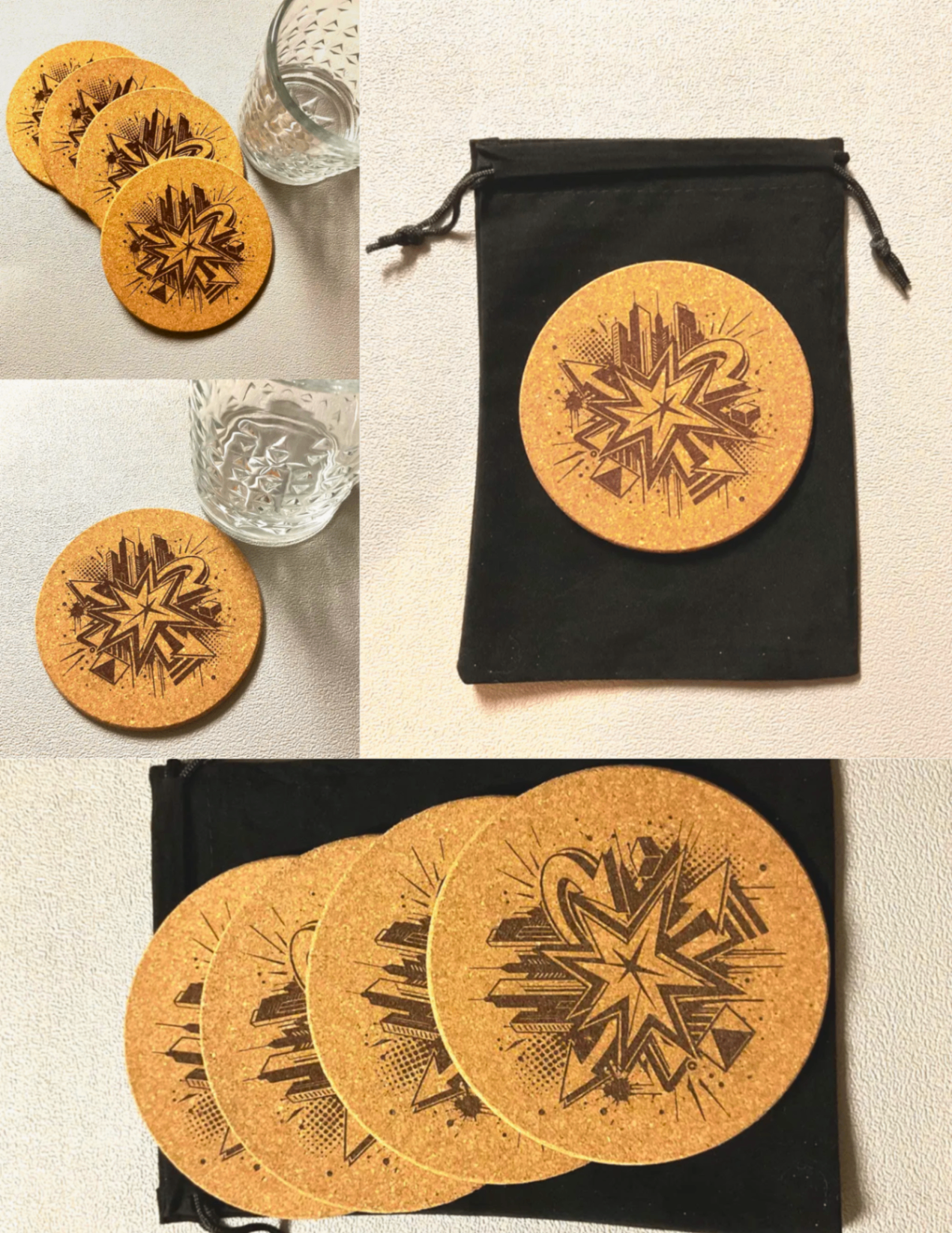
Our cityscape cork coaster set ships as a set of four with a velvet gift pouch. For custom artwork, logos, or bulk orders, see our laser etching services or reach out through the contact page.
A note on design
Cork rewards bold artwork. Because contrast comes from burn depth rather than color, fine hairline detail and subtle gradients get lost, while strong shapes, heavy linework, and halftone texture read beautifully. The cityscape design works for exactly that reason — high-contrast architecture, radiating burst lines, and dotted halftone shading are all things the material can hold.
If you are planning custom artwork of your own, the same rules we cover in designing a laser engraved dog tag apply here: simplify, increase contrast, and test at final size before committing to a full run.
Related reading: the coaster material guide and custom laser engraved gifts for every occasion.
Featured pieces
From the studio
Hand-strung and finished in-studio. Every piece from our shop can be restrung or re-set at cost — just reach out.
Keep reading
Laser Etching & Craft
The Cork Coaster Guide: Why Cork Is Our Go-To for Custom Laser-Engraved Coasters
A studio guide to custom laser-engraved cork coasters — why we use cork, how the etch holds up, design rules, and when a cork coaster set is the right call.
Laser Etching & Craft
Why Laser Etching Lasts a Lifetime: The Craft Behind a Permanent Mark
How laser etching bonds a design into metal, wood, and stone — why the mark outlasts ink and paint, and what to look for when you order a piece that should last.
Laser Etching & Craft
Custom Laser Engraved Gifts for Every Occasion: A Complete Guide
A practical guide to ordering custom laser engraved gifts — from dog tags and coasters to business cards — with ideas for birthdays, weddings, memorials, and corporate milestones.