Laser Etching & Craft · Guide
The Cork Coaster Guide: Why Cork Is Our Go-To for Custom Laser-Engraved Coasters
A studio guide to custom laser-engraved cork coasters — why we use cork, how the etch holds up, design rules, and when a cork coaster set is the right call.
By Robert Anthony · · 7 min read
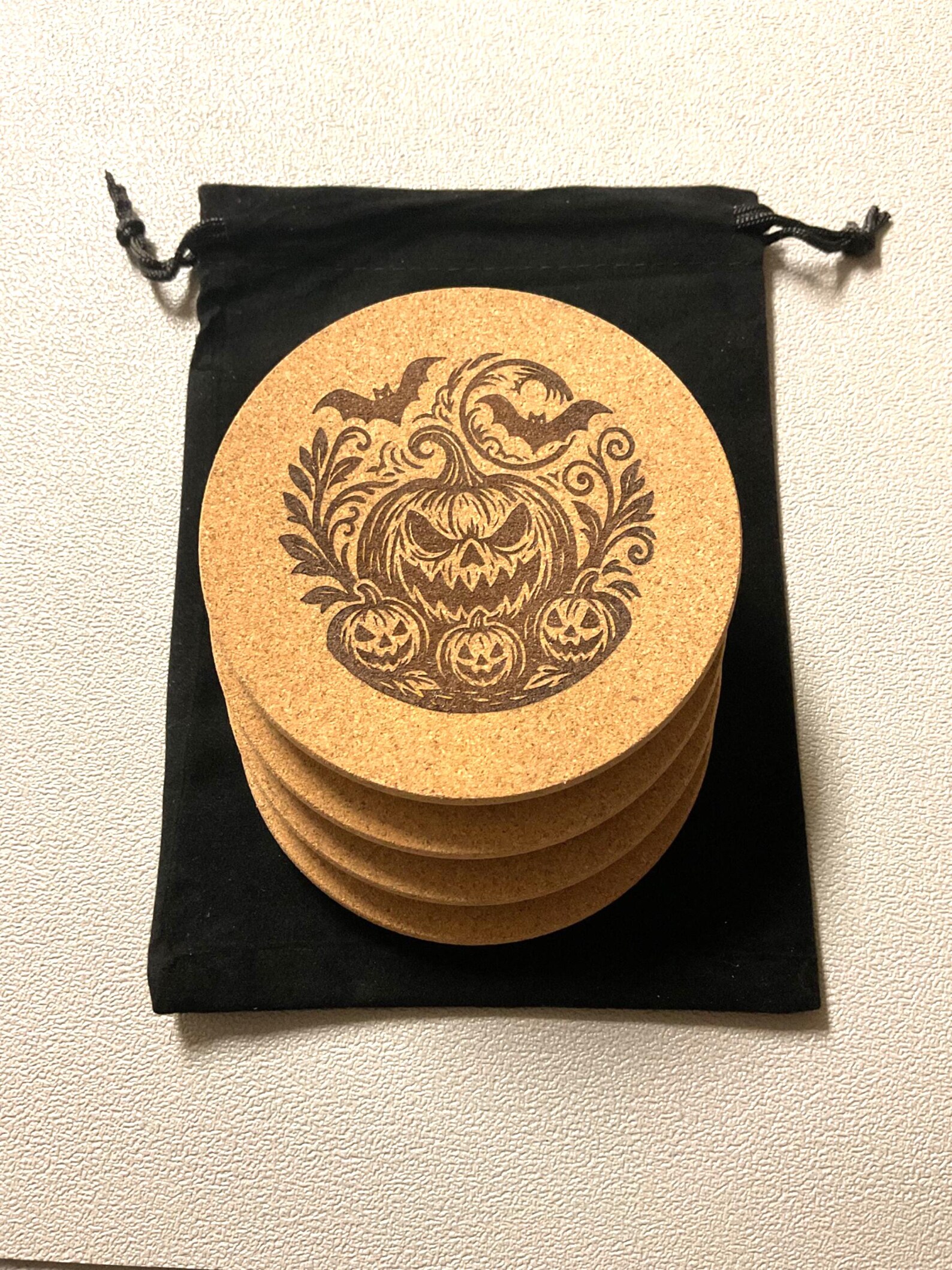
Custom laser-engraved cork coasters are one of the most requested pieces to come out of our studio — for weddings, closing gifts, restaurant branding, seasonal drops like our Spooky Pumpkin Halloween set, and small housewarming batches. Cork is quiet on a table, gentle on glassware, and the laser burns a soft dark-brown mark that feels warm and lived-in rather than showroom-shiny. This guide walks through why we default to cork, how the etch holds up, and how to design a set that reads clearly at coaster scale.
If you're new to the process, our laser etching explainer covers how the engraving itself works — the physics on cork are similar, only the surface reacts differently.
Why cork
Cork is harvested from the bark of the cork oak (background from Britannica) — a renewable material stripped every nine to twelve years without harming the tree. It's lightweight, naturally water-resistant on the surface but absorbent enough to catch a ring of condensation, and forgiving on both furniture and glassware. For a small studio like ours, it also ships beautifully: a stack of 50 cork coasters weighs a fraction of the same count in slate, so postage stays affordable and nothing arrives chipped.
How the etch looks on cork
When a CO₂ laser hits cork, it burns the top layer to a soft dark brown. Contrast is lower than slate or stone — you get warm brown on tan rather than bright white on black — but the trade-off is a design that feels natural, hand-touched, and instantly at home on a bar cart or café tabletop. Fine linework and bold typography both read well; halftones and photographic gradients do not.
What cork coasters are best for
- Large-volume orders for weddings, events, cafés, and closing gifts
- Anything mailed as a party favor or client gift — cork survives shipping unpadded
- Seasonal and holiday sets (our Halloween pumpkin coasters are a returning favorite)
- Bold logos, monograms, and simple illustrations rather than photo-realistic art
- Casual home use where absorbency and quiet-on-the-table matter more than presentation
Trade-offs worth knowing
- Lower contrast than slate — the etch reads as a burned brown rather than a bright white
- Absorbs coffee and red wine over time — treat a well-loved set as a consumable, not an heirloom
- Softer surface can compress under a very hot mug; use a trivet for cast-iron
- Cork thickness varies slightly piece to piece; part of the natural material's character
Design rules for cork coasters
- Vector art only. Rasterized logos come out fuzzy at coaster scale.
- Minimum stroke ~0.5pt. Below that, cork blurs the linework as it burns.
- High-contrast designs beat gradients. Laser etching is on/off — halftones look like stippling on cork.
- Leave a 1/4 inch safe margin off the edge; cork blanks vary slightly in cut.
- Test one before running fifty. We etch a sample on the exact stock before batching an order.
Care and cleaning
- Wipe spills with a slightly damp cloth — never soak; cork holds water
- Skip the dishwasher and the microwave
- Rotate through a set so the same coaster doesn't take every drink
- Let a wet coaster air-dry face up before stacking
How the etch itself works
The laser delivers focused energy that changes the surface state — on cork it burns a soft brown; nothing is printed and nothing is ink. That's why a laser-engraved cork coaster outlasts a printed or vinyl-applied version by years even as the cork itself weathers. Full breakdown in our laser etching explainer.
Order a set
Ready-made cork coaster sets — including our seasonal Spooky Pumpkin Halloween drop — live in the shop. For custom logos, wedding monograms, or brand runs, see set sizes and pricing on the services page, or reach out via contact with your design and quantity.
Related reading
Pair a cork coaster set with a personalized laser-engraved dog tag for corporate gifts, or read our take on handmade vs. mass-produced for why we run every coaster order through the studio ourselves.
Keep reading
Laser Etching & Craft
What Is Laser Etching on Aluminum? A Studio Explainer
How laser etching on aluminum actually works, what the equipment does, and why it holds up longer than stamped or printed alternatives.
Laser Etching & Craft
The Personalized Dog Tag Guide: What to Engrave
How to design a personalized laser-engraved dog tag — name conventions, phrases that age well, and layout limits.
Studio Notes
Handmade vs. Mass-Produced Jewelry: What Actually Differs
A practical breakdown of what changes when jewelry is made by hand — construction, materials, finishing, and longevity.