
Gemstone Guides · Guide
Stone Bead Bracelets: A Guide to Red Jasper, Bloodstone, and Everyday Wear
How stretch bead bracelets in red jasper and bloodstone are made, what the stones mean, how they wear day to day, and how to size and care for them.
By Robert Anthony · · 6 min read
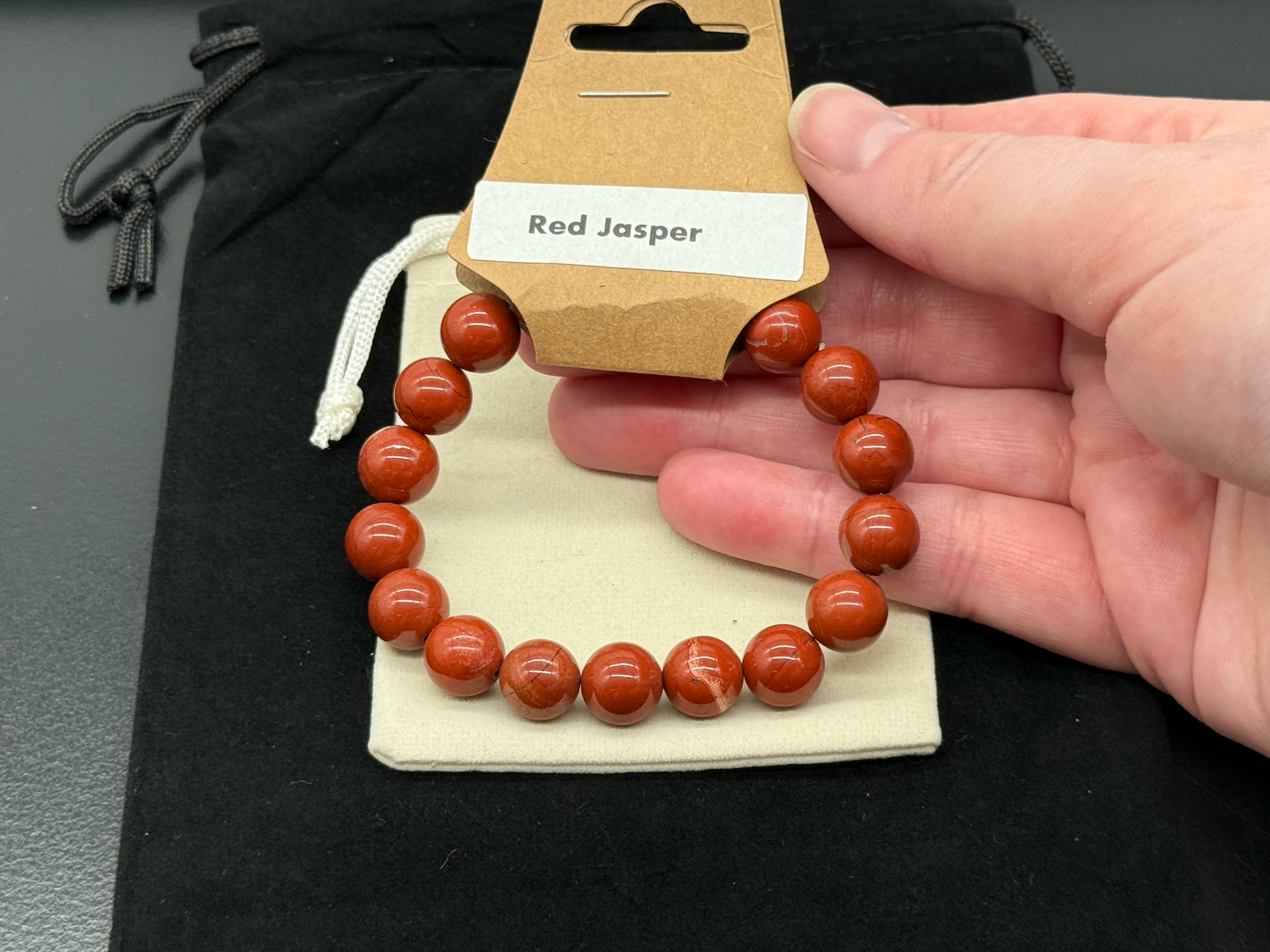
A stone bead bracelet is the most honest piece of jewelry we make. There's no clasp to hide behind and no metalwork to distract — just round, polished stone strung on elastic, sized to slip over a hand and settle at the wrist. Two of the ones people keep coming back for are red jasper and bloodstone, and they're a good pair to understand together: earthy, grounded, quietly different in character.
Red jasper — the grounding stone
Red jasper is a variety of chalcedony (microcrystalline quartz) colored by iron oxide inclusions. It's Mohs 6.5–7, which means it takes daily wear better than softer stones like sodalite or obsidian. GIA's overview of jasper covers the mineralogy; the color you see is real, not dyed, and no two beads are identical — expect subtle veining and shifts in tone across a strand.
In modern crystal traditions, red jasper is the stone of endurance and steady energy — the one people reach for when they want to feel planted rather than lifted. The full write-up on the stone is in the red jasper guide, and a shorter reference note lives at the red jasper reference.
Bloodstone — the quiet workhorse
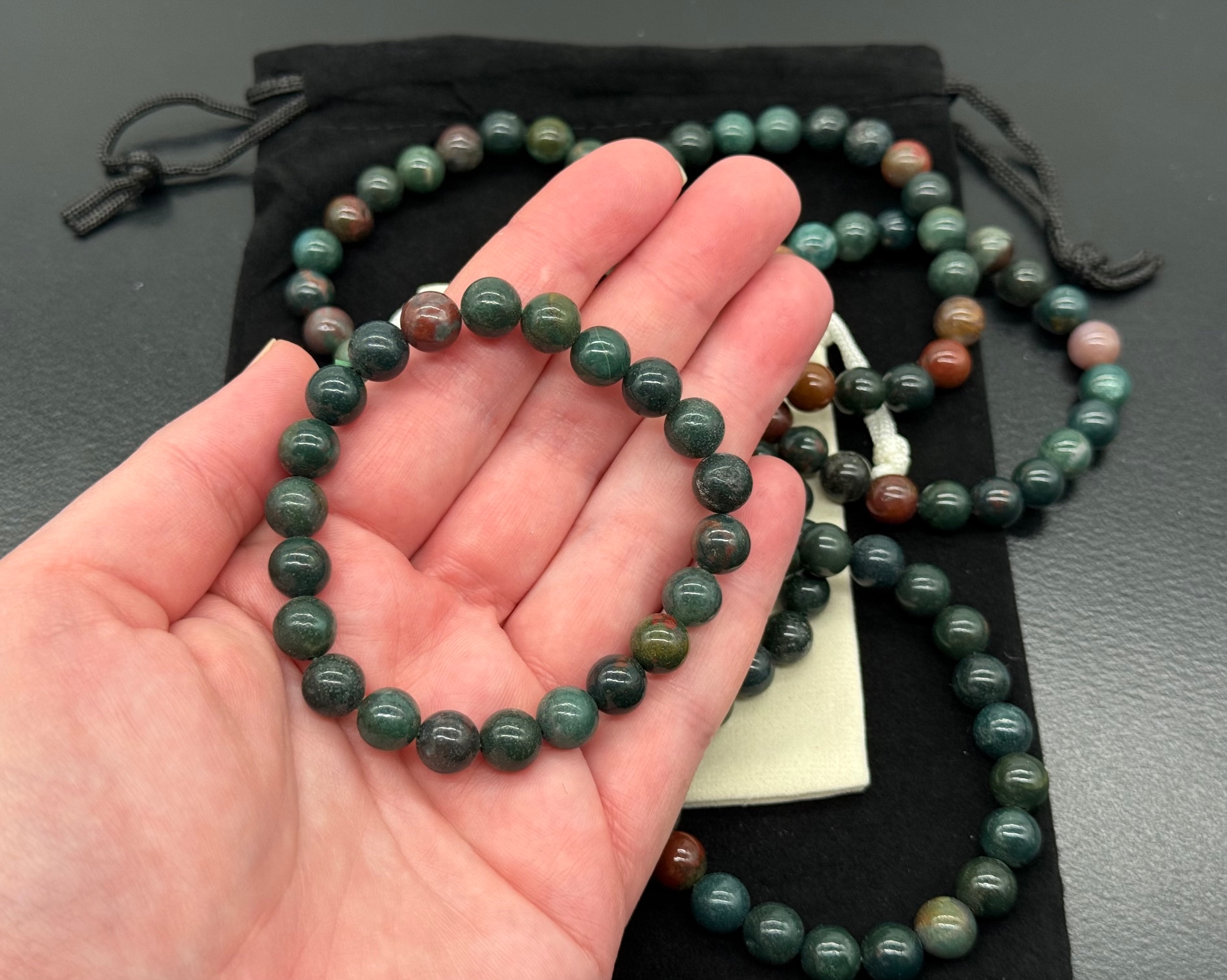
Bloodstone (also called heliotrope) is a dark green chalcedony spotted with red iron oxide — the "blood" in the name. It shares red jasper's family and hardness, so it wears the same way in practice. Mindat's entry for heliotrope covers the mineral record.
Traditionally, bloodstone was carried as a stone of courage and vitality — Roman soldiers, medieval carvers, and Renaissance seal-makers all used it. In a bead bracelet the effect is quieter than red jasper: from a distance it reads as deep green, and the red only reveals itself up close. It pairs well with black, olive, and warm neutrals, and it's one of the few stones that looks equally right on a construction site and under a shirt cuff.
How a stretch bead bracelet is made
- Beads are matched. We sort a strand for size consistency and pick out any beads with fractures or dead spots in color.
- Elastic is chosen for the bead weight. 8mm beads use a heavier cord than 6mm — undersized cord is the single most common failure point on cheap bracelets.
- The bracelet is strung and stretched. Pre-stretching the cord before knotting prevents the slow sag that makes cheap bracelets go loose in a month.
- The knot is doubled and hidden inside a bead. A single knot in view is where most bracelets break; a double surgeon's knot pulled into a bead is what makes one last.
Sizing — the part most guides skip
Measure the wrist snugly with a soft tape or a strip of paper, then add half an inch for comfort. That's your bracelet length. For 8mm beads that usually means 21–23 beads; for 6mm, 26–28. If you're between sizes, size down — a stretch bracelet that spins slightly is correct; one that slides off the hand isn't.
- Small wrist: 6.5–7 in bracelet length
- Medium wrist: 7–7.5 in
- Large wrist: 7.5–8 in
How they wear day to day
Both stones are hard enough for daily wear, but bead bracelets take more abuse than pendants — they rub against desks, steering wheels, gym equipment, and each other when stacked. A few habits keep them looking new:
- Take them off for the gym, dishes, and showers — soap film dulls the polish over time.
- Store them flat, not hung — hanging stretches the cord.
- Wipe with a soft dry cloth after wear; skip ultrasonic and steam cleaners.
- Restring every couple of years if you wear them daily. The stones outlast the elastic.
The full care routine — including what not to do — is in the stone care guide.
Stacking and pairing
Red jasper and bloodstone stack cleanly together — they share a warm-earthy palette without competing. Add a neutral like black onyx or matte hematite for contrast, and keep the total to three or four bracelets on one wrist so the stack reads considered rather than crowded. For pairing bracelets with pendants, the layering guide covers the same principles for necklines.
Where to find them
We keep a rotating selection of stone bead bracelets in the studio — most in the $20 range, in both 6mm and 8mm. Browse current inventory, or message the studio if you want a specific stone or wrist size held aside.
Keep reading
Gemstone Guides
Red Jasper: The Grounding Stone of Endurance, Courage, and Steady Energy
A complete guide to red jasper — its geology, history, symbolism, and why this deep-red stone has been carried for thousands of years.
Gemstone Guides
Red Jasper: An Earthy, Everyday Stone
What red jasper is, how it forms, and why it's one of the most forgiving stones for daily wear.
Stone Care & Cleaning
How to Care for Natural Stone Jewelry: A Complete Guide
Clean, store, and protect natural stone jewelry — from amethyst to obsidian — with a jeweler-tested care guide built to last.
Styling & Wearing
Layering Necklaces: Lengths, Pairings, and What Not to Do
A studio guide to layering stone pendants and chains — chain lengths, tangling prevention, and how many is too many.