Gemstone Guides · Guide
How to Read a Gemstone Listing Before You Buy
Decode the language in gemstone jewelry listings — treated, dyed, reconstituted, natural, and lab-created — so you know exactly what arrives in the box.
By Robert Anthony · · 8 min read
Most disappointment with gemstone jewelry is not fraud. It is vocabulary. Two listings can describe the same $20 pendant and one of them tells you the truth in words you did not know to read.
The five words that carry all the meaning
- Natural — mined, cut, polished. Nothing added to the color or structure.
- Treated / enhanced — heated, irradiated, or resin-stabilized. Legal and common; must be disclosed under FTC guides.
- Dyed — porous stone soaked in colorant. Fades with UV and skin oils.
- Reconstituted / composite — ground mineral bonded with resin, then re-cut. Often sold as turquoise or amber.
- Lab-created / synthetic — chemically identical to natural, grown in a lab. Not a fake; just not mined.
Price signals that mean something
The FTC Jewelry Guides require sellers in the US to disclose treatments and to avoid implying a stone is natural when it is not. A listing that never uses the words "natural" or "treated" anywhere is telling you something by omission.
- Amethyst under $10 in a large size is usually heat-treated or synthetic.
- "Turquoise" under $15 is nearly always stabilized or reconstituted howlite.
- "Opalite" is glass. It is beautiful glass, and honest sellers say so.
- Perfectly uniform color across a whole strand suggests dye, not luck.
Hardness tells you how it will age
Check the Mohs hardness before you buy anything you plan to wear daily. Below 6 and household dust — which is largely quartz at 7 — will scratch the polish off within a year of daily wear.
Questions worth asking a seller
- Is the stone natural, treated, or lab-created?
- What is the actual pendant size in millimeters?
- Is the setting the same metal as the chain?
- Where was the stone cut?
A small studio should be able to answer all four in a sentence. If the answer is a paragraph of marketing, that is your answer.
Free tools for verifying what you were told
- GIA Gem Encyclopedia — the authoritative free reference for species, treatments, and durability.
- Mindat — open mineral database with locality data and real specimen photos.
- USGS Mineral Information Center — free production and sourcing data by mineral.
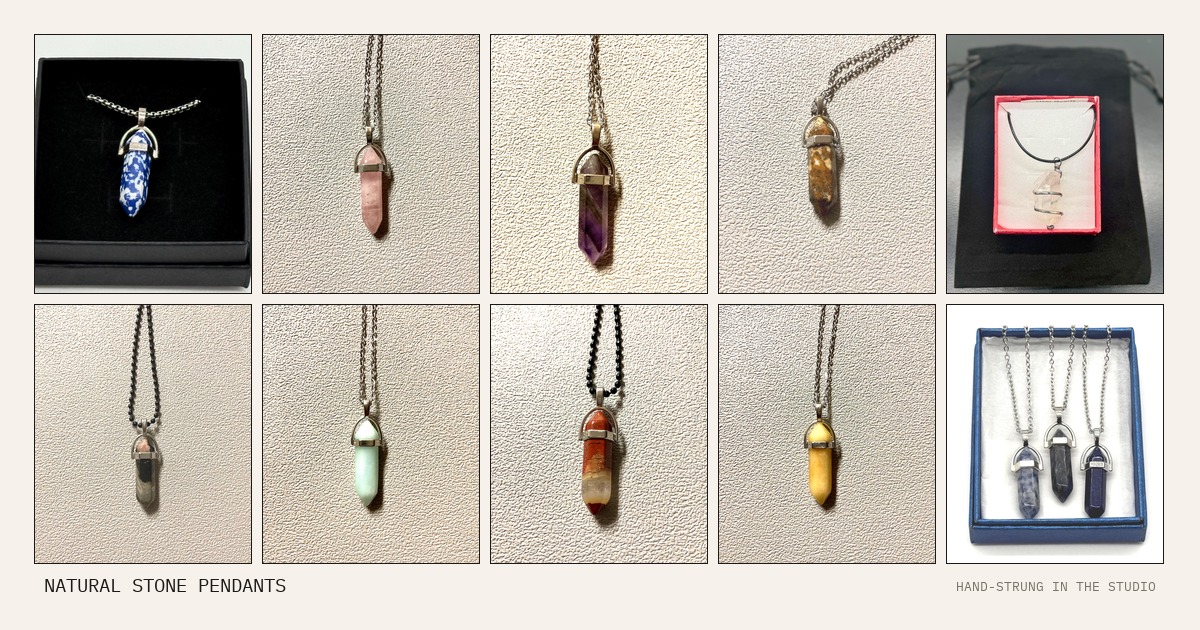
Everything we sell is described the way we would want it described to us. Browse the stone pendants or read about how we source.
Featured pieces
From the studio
Hand-strung and finished in-studio. Every piece from our shop can be restrung or re-set at cost — just reach out.


Keep reading
Gemstone Guides
How to Find a Good Deal at Your Local Jewelry Store (and Know What You're Buying)
A buyer's guide to jewelry store pricing, gemstone grading, metal stamps, and treatments — how to spot real value and avoid paying for markup instead of material.
Studio Notes
Why We Source Natural Stones (and How We Choose Them)
A studio note on why every stone we sell is natural, how we vet suppliers, and what that means for the pieces you wear.
Styling & Wearing
Raw Crystal vs. Polished Stone: Which Pendant Is Right for You?
A practical comparison of raw crystal pendants and polished stone pendants — how each wears, how each catches light, and how to choose.