Laser Etching & Craft · Guide
Laser Engraved Leather Patches: How They're Made and Why They Last
A studio look at laser engraved leather patches — how the burn works, what leather does under the beam, and how to spec patches for hats and jackets.
By Robert Anthony · · 6 min read
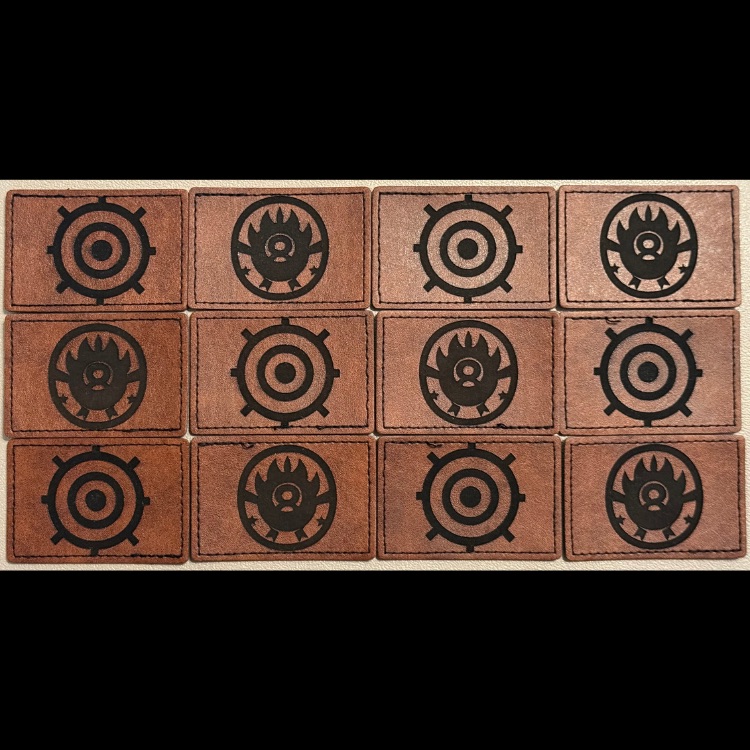
We ran a batch of leather patches in the studio today — twelve of them, two alternating emblem designs, all cut and burned on the same sheet. Leather is one of the most forgiving materials a small laser can work with, and it's one of the fastest ways for a small shop to add branded hats, jackets, bags, and patch sets without buying embroidery equipment.
What actually happens to leather under the beam
Engraving leather is a controlled burn. The laser removes the top layer of the hide and darkens the fibers underneath, so the mark is the leather itself — not ink, not thread, not a printed transfer. That's why the contrast in the patches above is brown-on-brown rather than a flat black overlay. Laser engraving works the same way across materials; leather simply chars where metal oxidizes.
- Veg-tanned leather darkens to a rich chocolate and gives the deepest contrast.
- Chrome-tanned leather engraves lighter and can smell harsher — good for softer, drapier patches.
- Faux/PU leather engraves cleanly and consistently, but the mark sits in the coating rather than the hide.
Designing a patch that reads from across a room
A patch is small and it's usually seen in motion — on a cap brim, a jacket chest, a tote. That kills fine detail fast. The emblems in this batch are bold circles with thick strokes for exactly that reason.
- Work in vector, not raster. Clean paths burn clean edges.
- Keep line weight at 1mm or heavier so nothing closes up when the fibers char.
- Avoid gradients — leather doesn't hold halftones well at this size.
- Leave 3–5mm of margin inside the stitch line so the design isn't crowded when it's sewn on.
- Test one piece before running the batch. Every hide runs slightly differently.
Why leather patches make sense for small brands
- Fast turnaround — a dozen patches run in minutes, not days.
- No minimums — a boutique can order twelve, not twelve hundred.
- Repeatable — the same file produces the same patch a year from now.
- It ages well — the burn is part of the hide, so it patinas with the leather instead of cracking off it.
Care
Keep patches dry when you can, and condition the leather occasionally with a standard leather balm — a light coat is enough, and it will deepen the engraved areas slightly. Don't scrub an engraved patch with a stiff brush; the charred fibers are the artwork.
Want patches made?
We run leather patch batches out of the studio in Vacaville, California alongside dog tags and coasters. If you have a logo or an emblem, send it through the contact page and we'll spec a patch size and run a test piece. You can see the rest of what comes off the laser on the custom etching services page or in the shop.
More on the process: what laser etching does to aluminum and why laser etching lasts a lifetime.
Keep reading
Laser Etching & Craft
What Is Laser Etching on Aluminum? A Studio Explainer
How laser etching on aluminum actually works, what the equipment does, and why it holds up longer than stamped or printed alternatives.
Laser Etching & Craft
Why Laser Etching Lasts a Lifetime: The Craft Behind a Permanent Mark
How laser etching bonds a design into metal, wood, and stone — why the mark outlasts ink and paint, and what to look for when you order a piece that should last.
Laser Etching & Craft
Boutique Laser Engraving Studios: Why Small Shops Do the Best Custom Work
What a boutique laser engraving studio actually offers — smaller runs, real proofs, tighter design work, and pieces you can't get from a big print-on-demand shop.